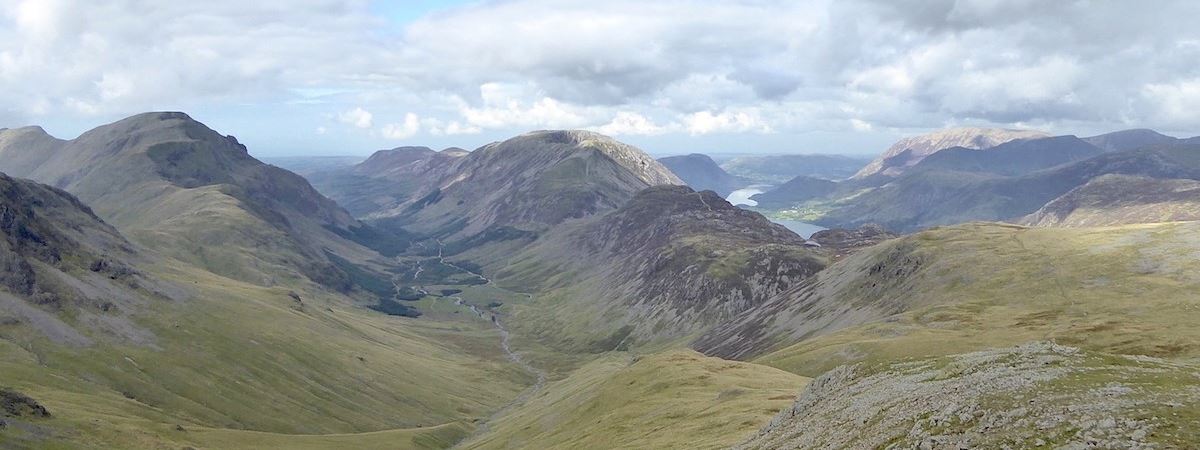
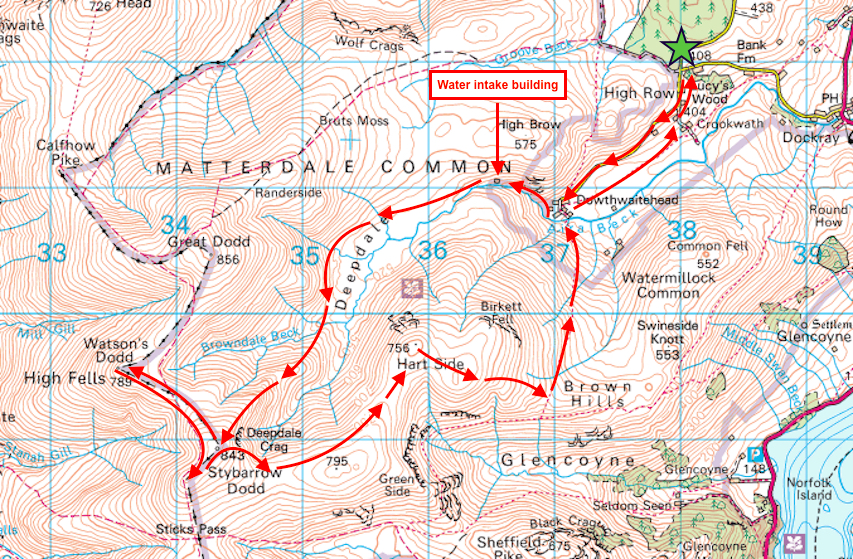
Stybarrow Dodd, Watson’s Dodd and Hart Side

Walk Date – 17th March 2016

Distance – 9.9 miles

Weather – very warm with blue sky and sunshine all day


Route
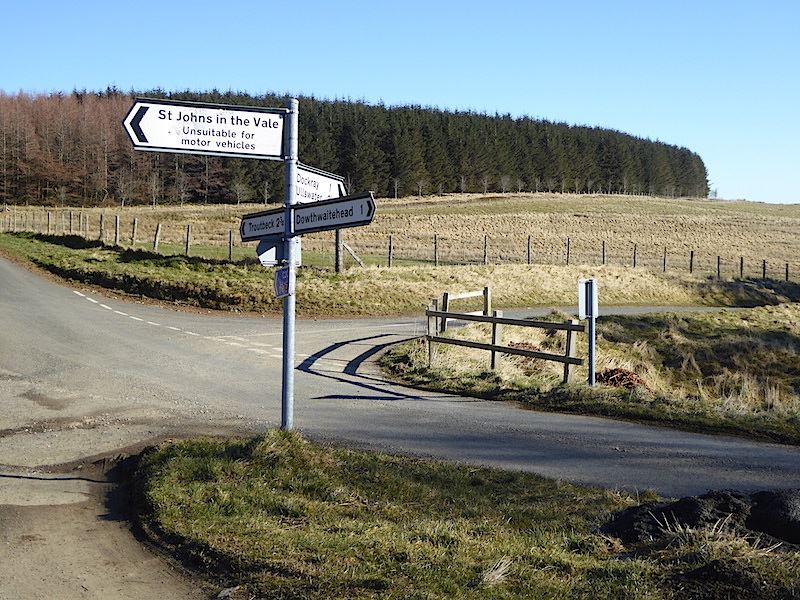
The fine dry weather continues and we have a free day, so here we are parked up at High Row near Dockray on a really lovely morning. There isn’t a cloud to be seen and the sunlight is so bright it is casting very strong shadows everywhere. Within seconds of putting them on my sunglasses had turned as dark as it was possible for them to go and I could see barely a thing through them, so I gave up and made do with lots of eye squinting for the rest of the day. This is as near to the start of the footpath as we can get so we have one mile of road walking along to Dowthwaite Head before we can really get going properly.

The January born triplets checking out the latest arrivals as they are brought into the fields for the first time.
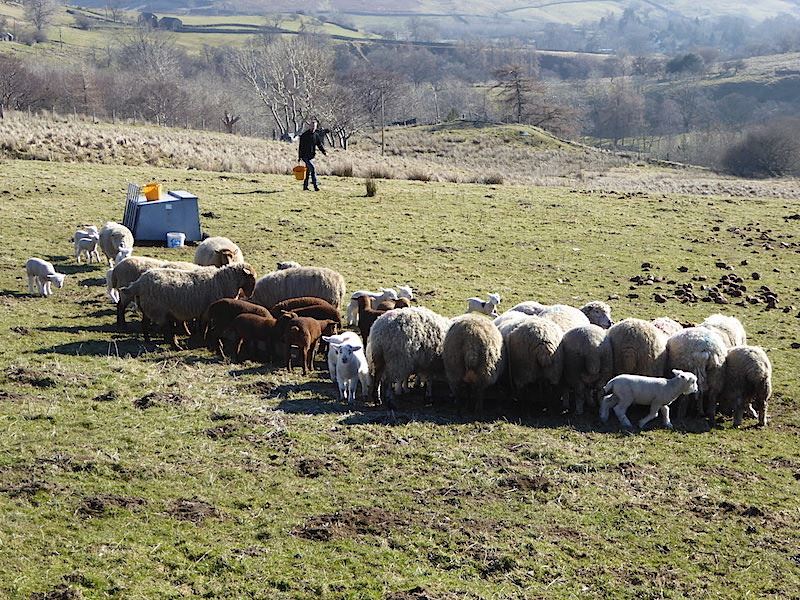
Heads down and tucking in now that the farmer’s Dutch helper has filled the troughs with sheep treats. The farmer stayed on board his quad bike and shouted instructions to the helper down in the field, in between chatting to us and telling us all about the different types of sheep he had, when the lambs were born, and that we’d see lots of others as we walked along to the farm at the head of the lane. Apparently his Dutch helper used to come over and help out when he was in his teens but has a wife and family now so he hadn’t been able to visit for a few years. He seemed to be enjoying it though despite all the shouted instructions from the farmer .
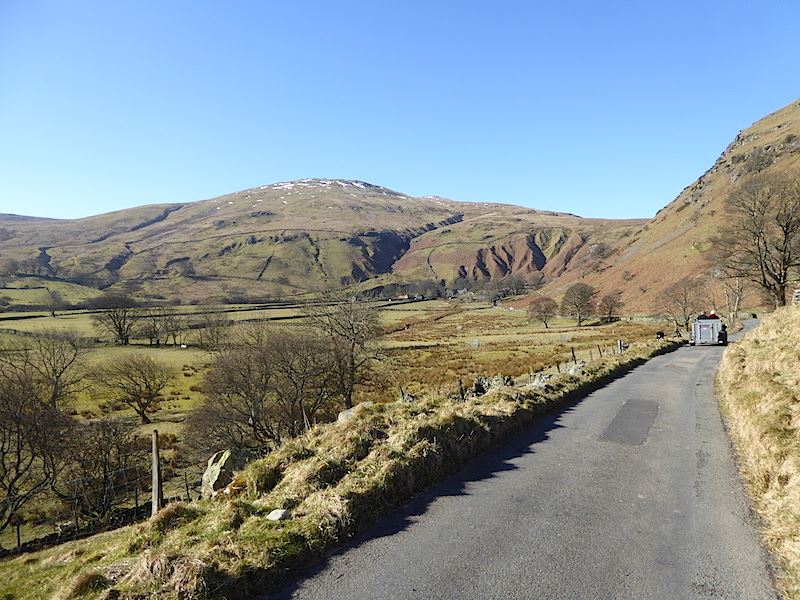
There they go, off to the next field. We caught up with them again checking on a lamb, only just born a few minutes earlier, and its mother. The ewe seemed to be concentrating on producing another lamb so the helper had to run down and check on the first born lamb. Its head was up and it was breathing so all was well.
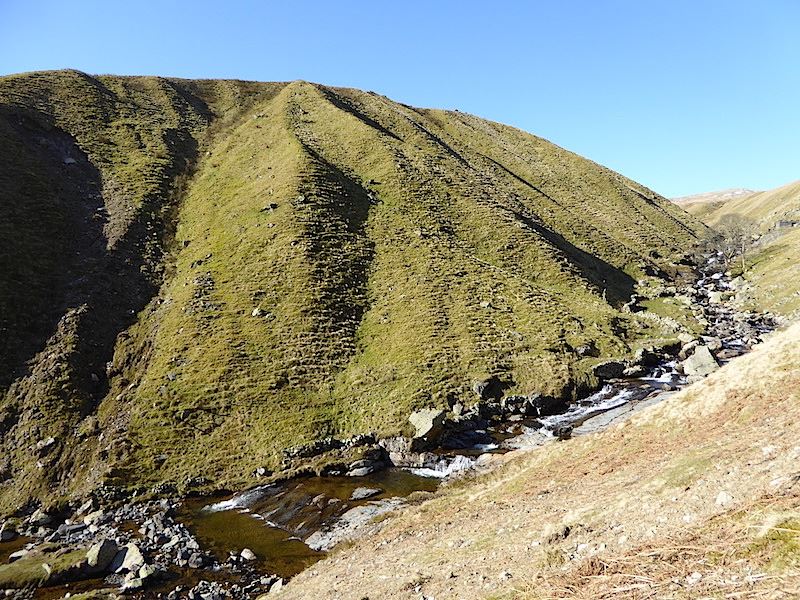
When we reached the farm the farmer asked us where we were heading for and when we told him Deepdale he screwed up his face and said it was an awful wet place and what did we want to go there for. He probably thought we were mad for wanting to go there but he was helpful enough to point out where the footpath started. It would have been difficult to locate it without his help as it required threading a way through the farmyard, through a gate and then following a faint path out onto the open fell alongside Rush Gill. He waved us off and said he was off for his breakfast. So here we are looking down at some of the waterslides in Rush Gill from an old footpath just above it. This is somewhere we haven’t walked before and the gill was a pleasant and very pretty surprise.
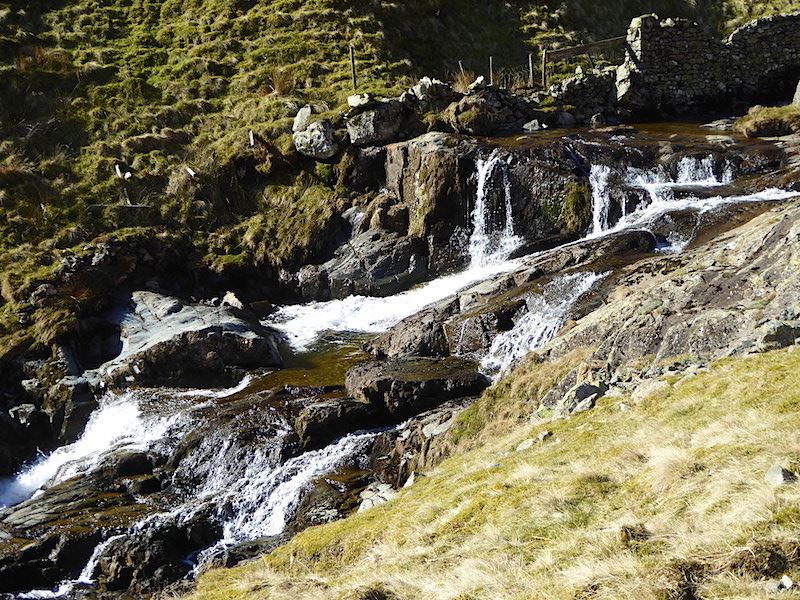
More waterfalls in Rush Gill and there were many others, all slightly different in appearance, all the way along. On such a lovely morning it was really nice to be walking along here.
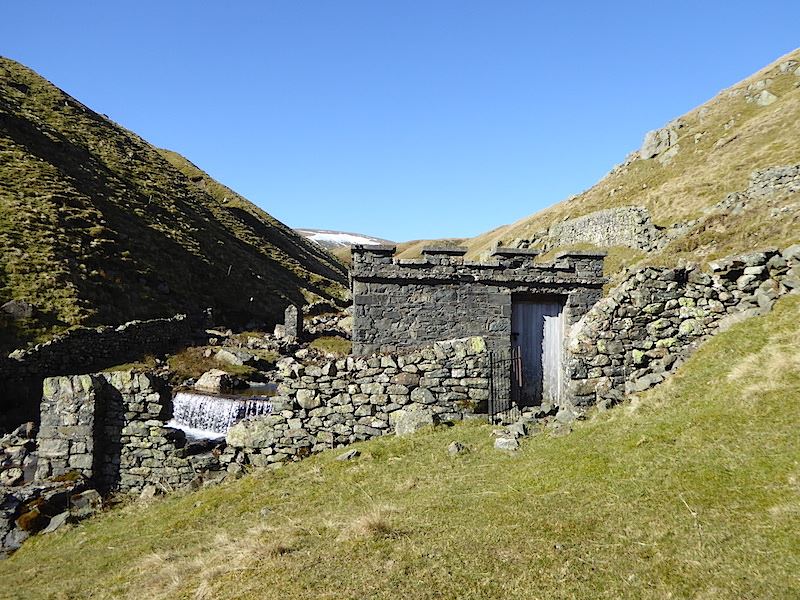
A little further along and we came across this, which I think is an old water intake building. I don’t know if it still in use though, the door was padlocked but the window at the back had no glass in it so it is open to the elements.
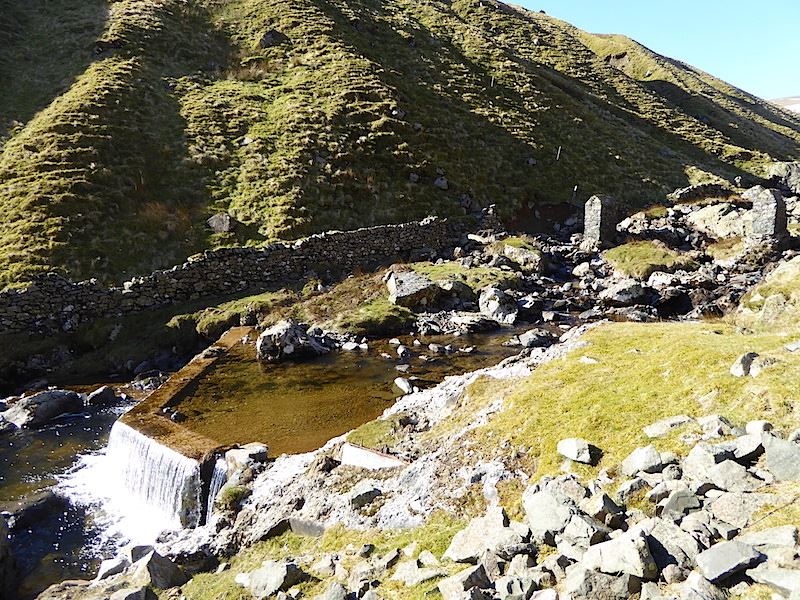
I scrambled over the rocks to the rear of the building and took this shot of the weir in the gill. I wanted to have a look in through the glassless window but the steepness of the slope and the looseness of the rocks underneath it made it too difficult to get a firm foothold so I have no idea what is inside the building.
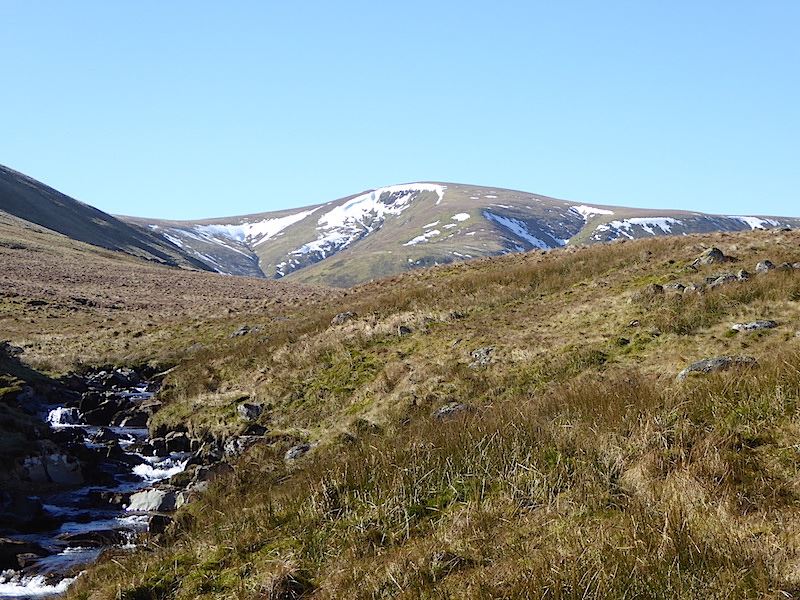
The path eventually comes out at Dowthwaite Head Moss, ‘the awful, wet place’ as described to us earlier by the farmer. Here we get our first view of Stybarrow Dodd, in the centre, still clinging on to a few patches of snow.
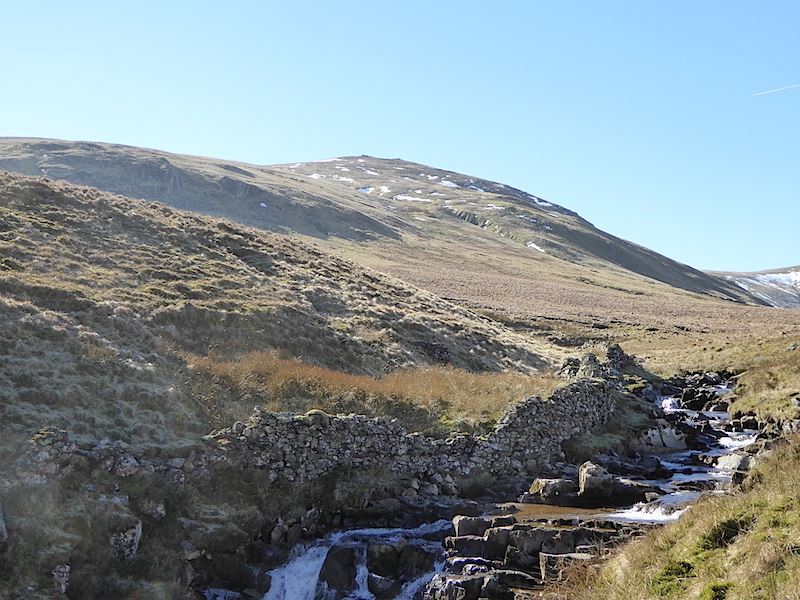
Over on the left we have a view of Hart Side which will be the last fell we will visit on our walk today.
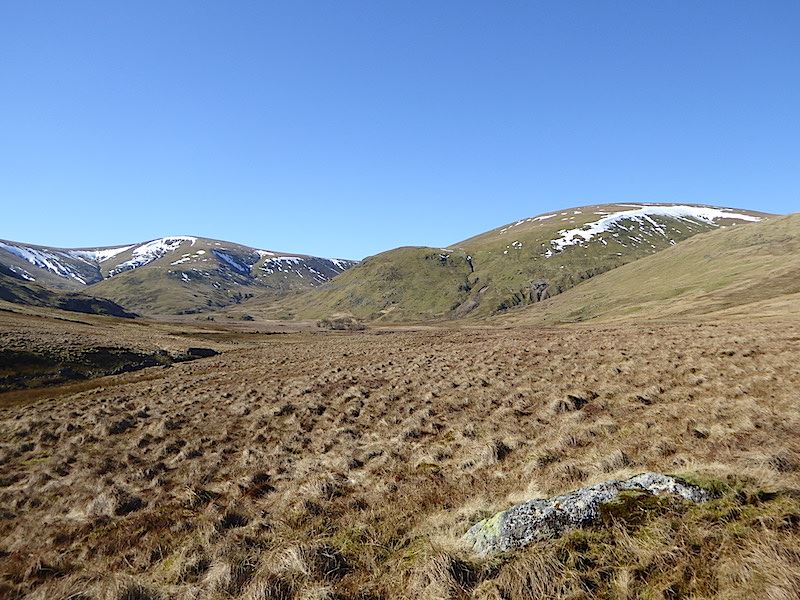
We’ve climbed out of the gill and we’re looking into the head of Deepdale. The farmer may not be too keen on this place but on a day like today you can appreciate its wild beauty. Yes, of course its wet, its very flat so all the water running off the fells collects in it and some of it will eventually drain into the gill. There isn’t a clear footpath but sheep trods can be followed from time to time, and keeping to the lower edges of the surrounding slopes helps to avoid the worst of the wetness. Given the amount of rain we had over the winter months I was surprised that the whole place wasn’t actually under water.
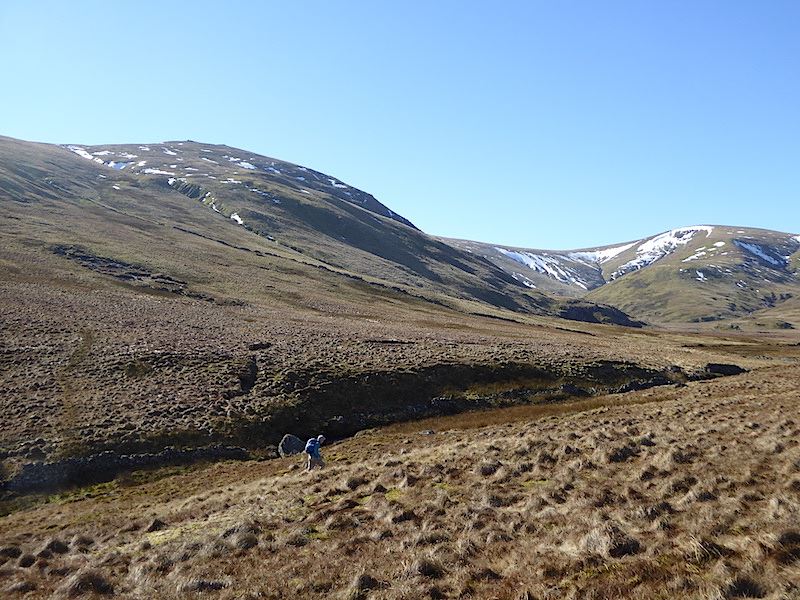
On the left is Hart Side and to the right is Stybarrow Dodd, where we will be walking straight up the grassy area known as Middle Tongue.
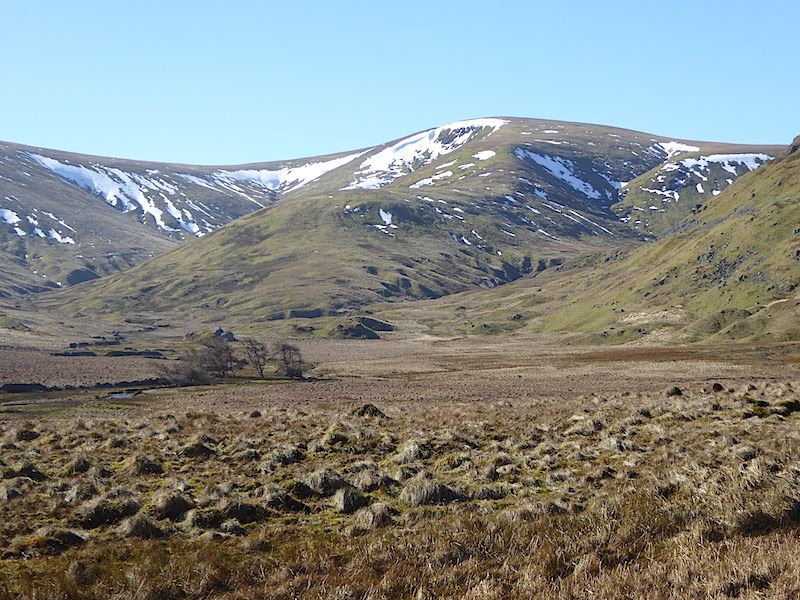
Skirting round Dowthwaite Head Moss, there’s no-one around and we don’t expect to see anyone either until we are on Stybarrow Dodd summit. This will never be a well trodden route because of its wetness.
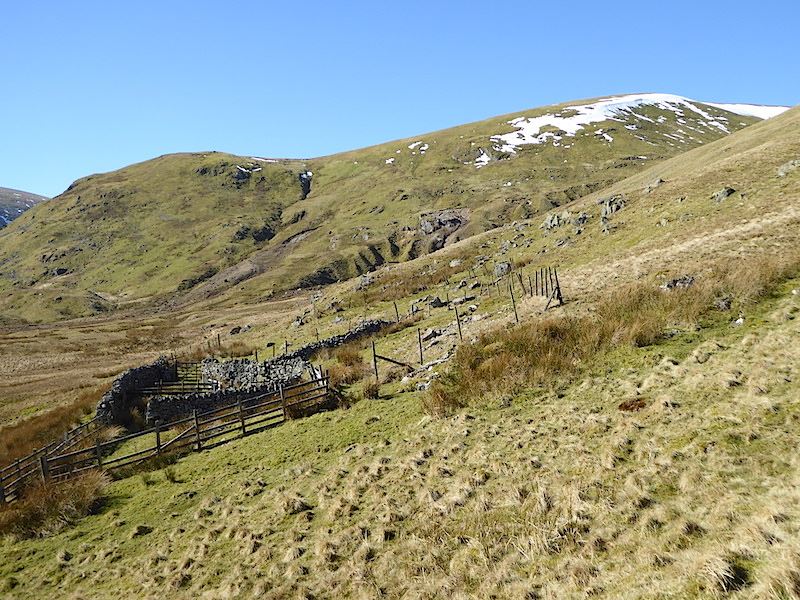
Dry ground under our feet as we approach Randerside Fold. The fell with snow behind it is Great Dodd with Lurge Crag down at the end of it.
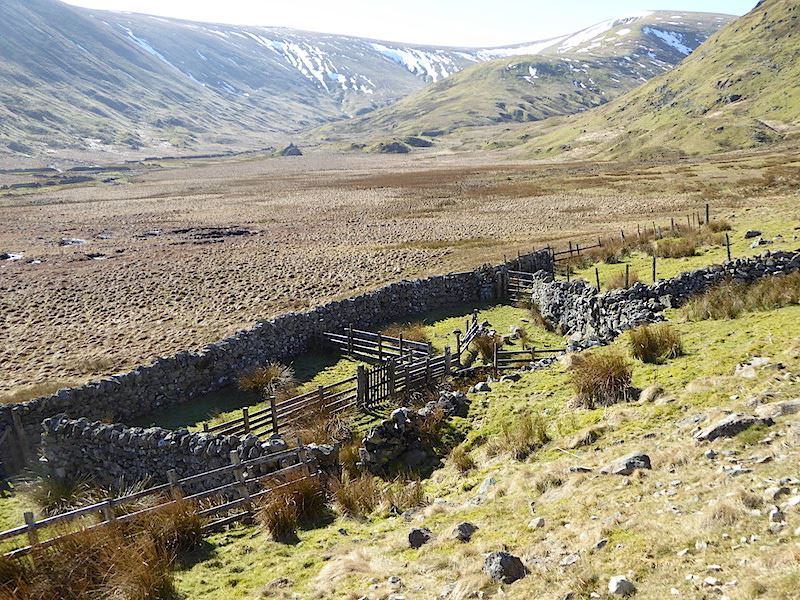
The view down to the sheepfold as we pass above it.
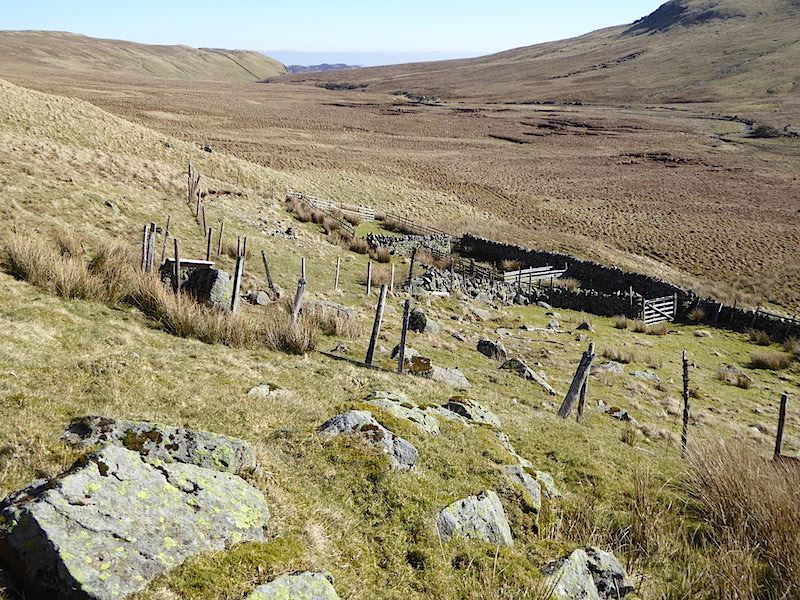
As there was some good seating available we decided that this would be a good place for a short refreshment stop. We have a view of the sheepfold, practically the whole of Deepdale Moss, and even Gowbarrow, the dark lumpy fell just visible above the v shape on the skyline. Not a breath of wind and a lovely little sun trap for a ten minute break.
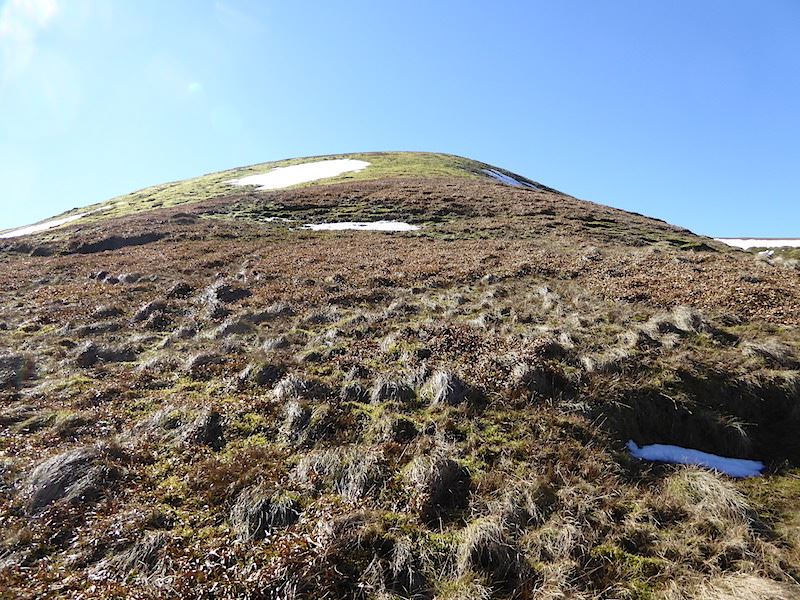
After our break we continued on, crossed Browndale Beck and commenced the steep climb up Middle Tongue. Slow progress up here, hot sun, wet tussocky grass and not much of a view in front of us.
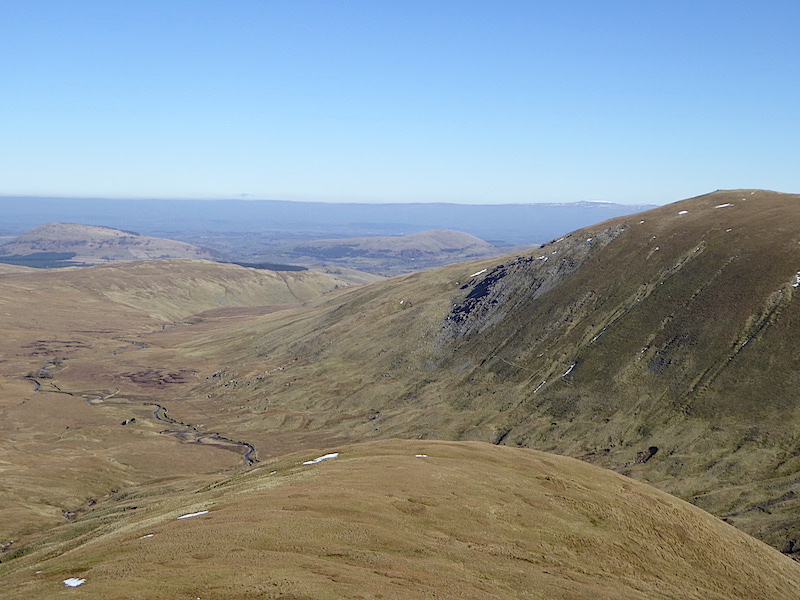
Frequent stops were required on the way up here, to get your breath back, to give the calf muscles a chance to rest, have a drink, take a photo or admire the view. The two isolated humps are Great Mell Fell, to the left, and Little Mell Fell in the centre. Hart Side is over on the right and just behind it is the snow capped Cross Fell over on the northern Pennines.
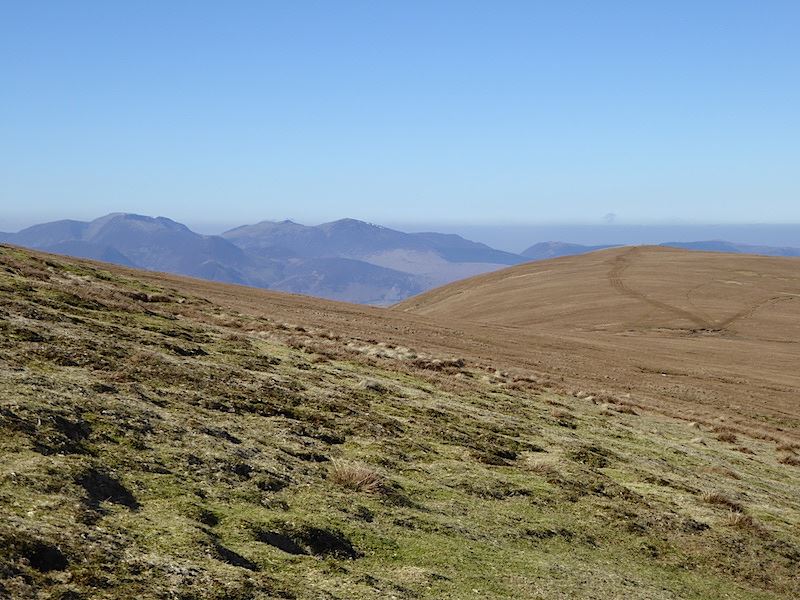
Over to the right the path to Watson’s Dodd appears with some of the north western fells to the left of it. We are still going uphill though as we haven’t reached the top of Stybarrow Dodd just yet.
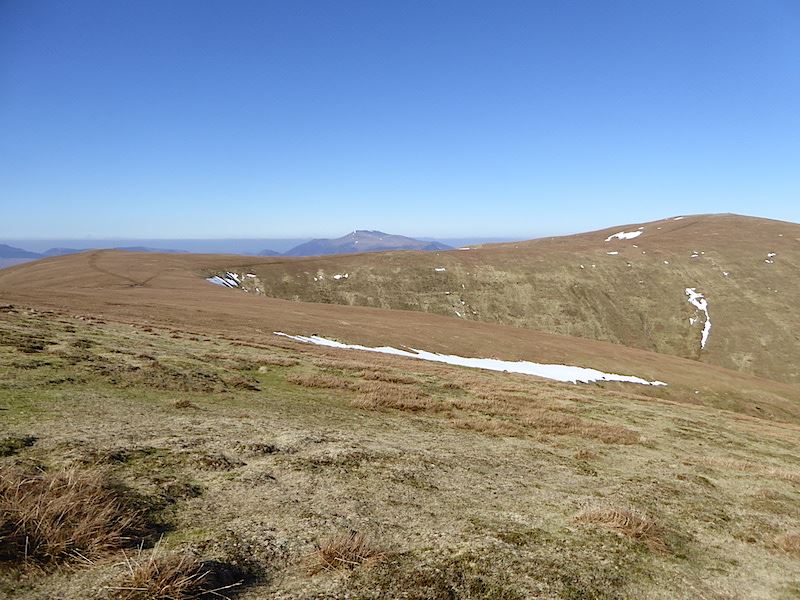
The ground eventually flattens out onto the summit area, the legs give a sigh of relief and we have a view over towards Watson’s Dodd to the left with Great Dodd to the right. In between the two is Skiddaw.
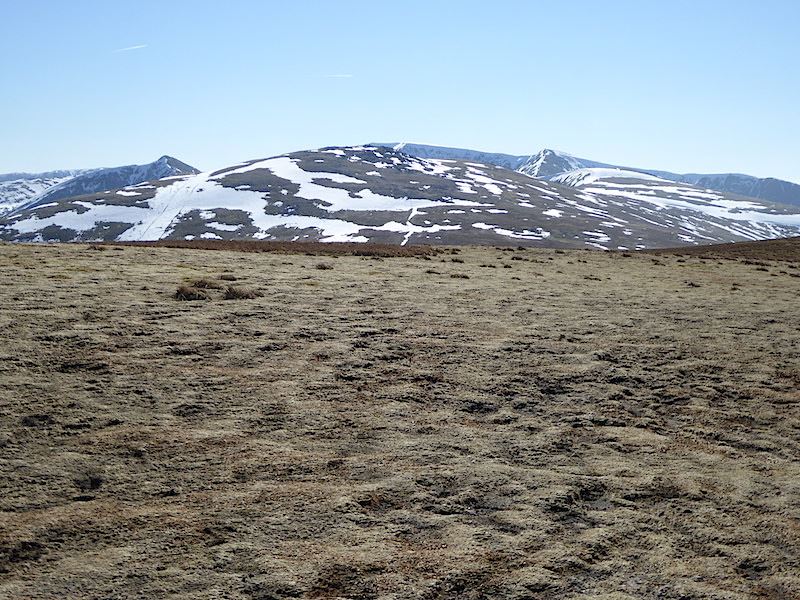
The bliss of flat ground once more and a view of Catstycam, on the left, Raise in the middle, with the plateau of Helvellyn just behind it.
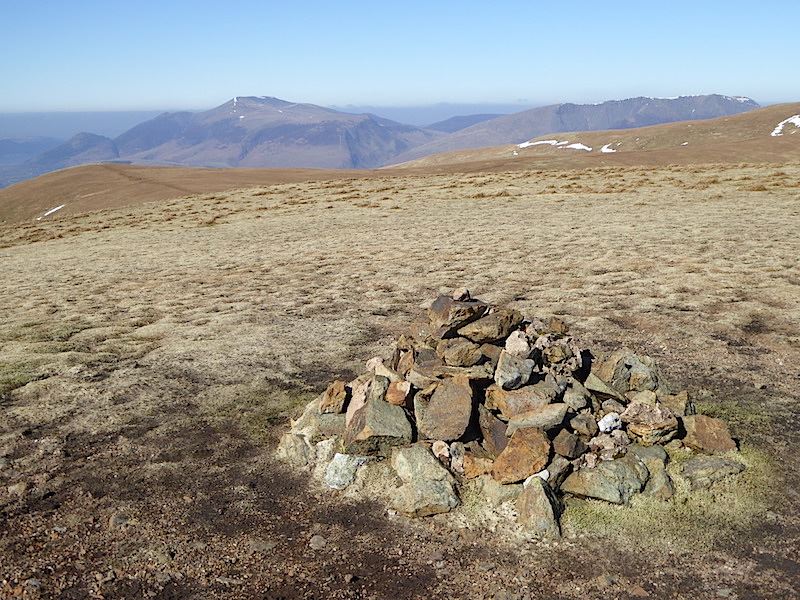
Stybarrow Dodd summit with Skiddaw on the left and Blencathra on the right. From here we took the path over on the left to Watson’s Dodd and a stop for something to eat.
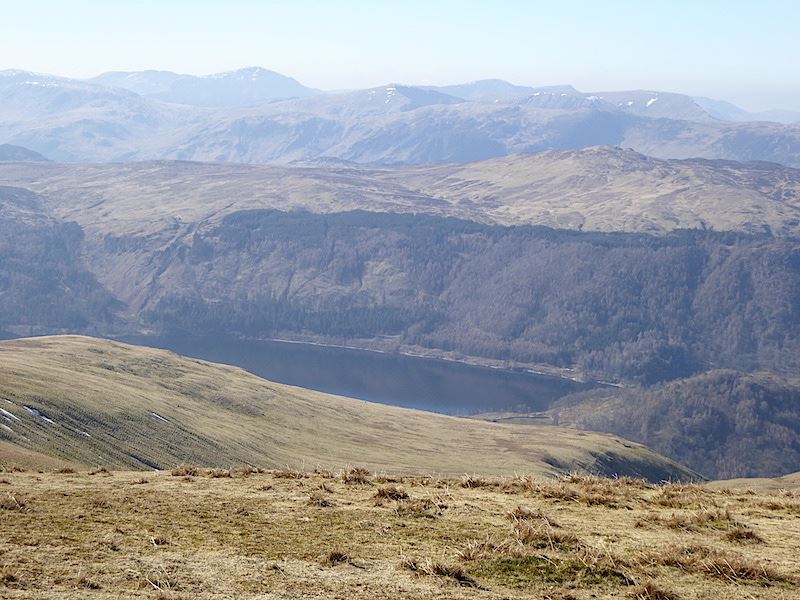
A section of Thirlmere below us as we begin to walk over to Watson’s Dodd.
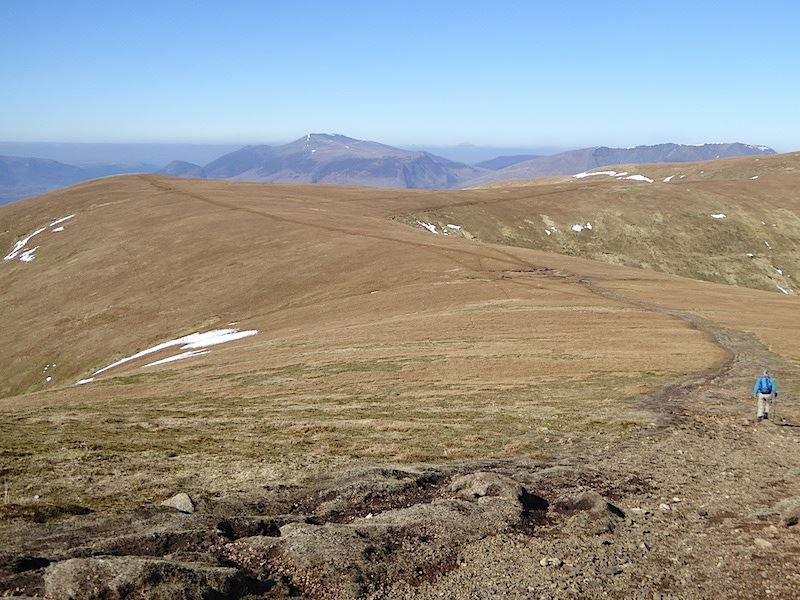
Making our way over to Watson’s Dodd. Very little chance of losing the path here, its so well trodden as you can see.
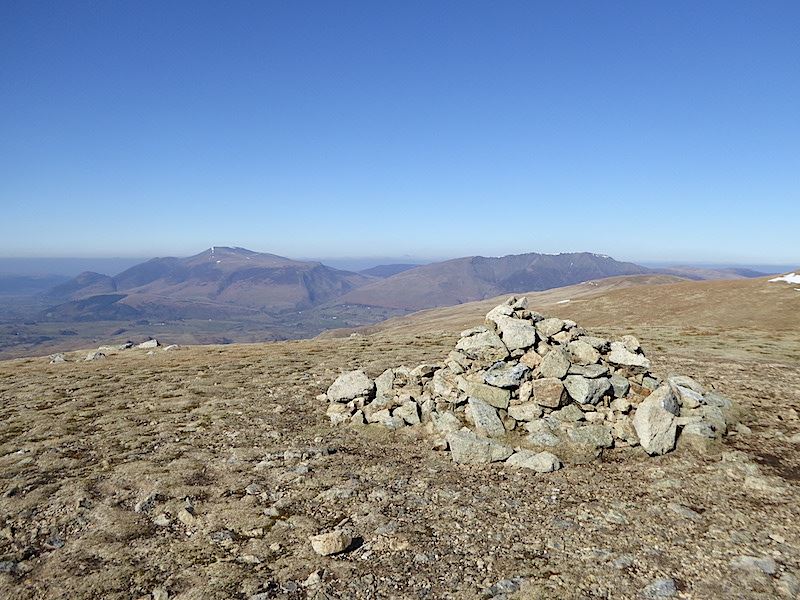
Thirteen minutes later and we arrive at Watson’s Dodd summit with Skiddaw and Blencathra dominating the northern fells. The Watson whose name this fell commemorates seems to be unknown.
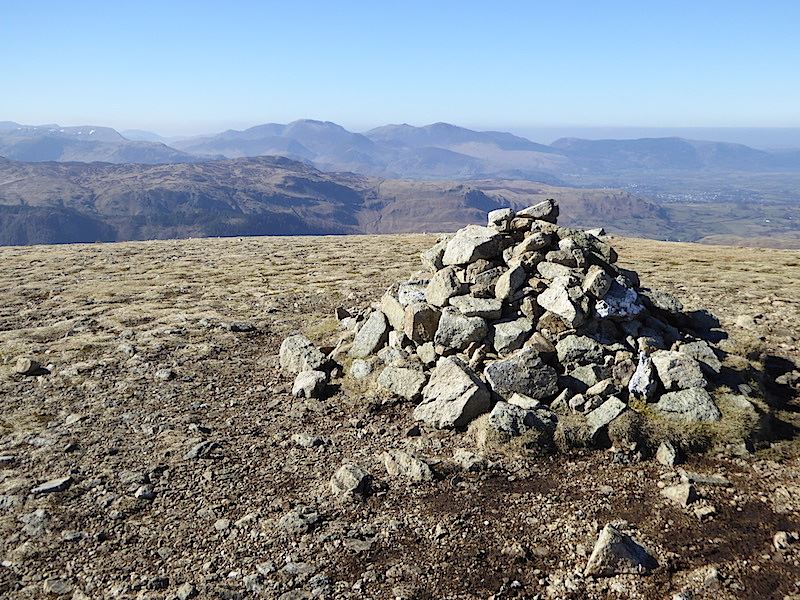
Looking towards the north western fells across Bleaberry Fell.
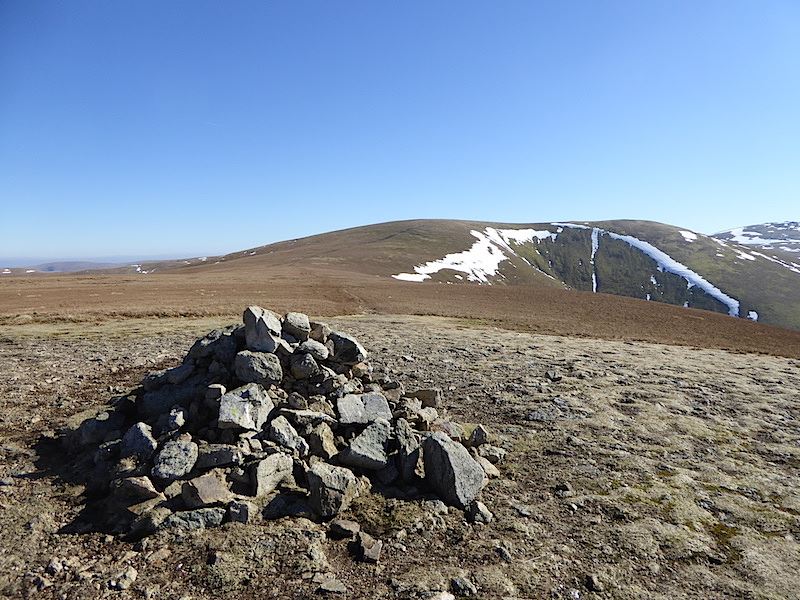
From Watson’s Dodd a look back at Stybarrow Dodd.
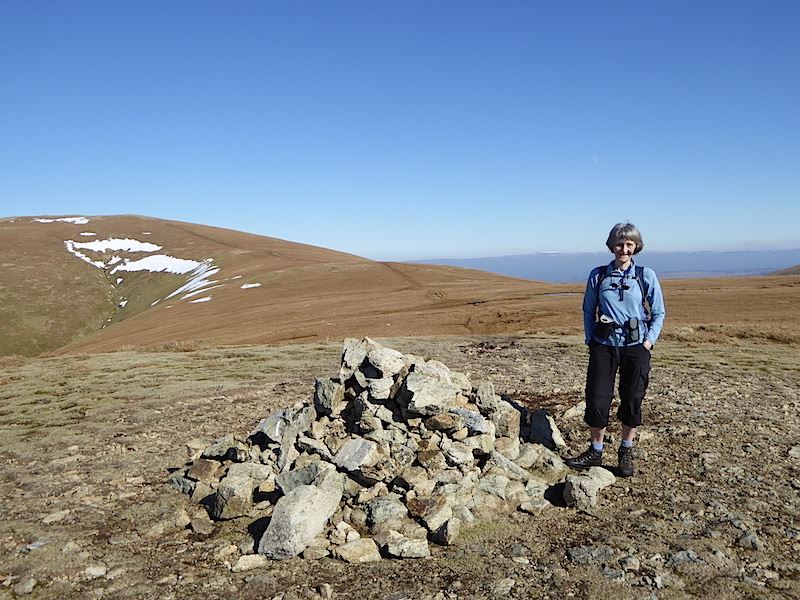
Great Dodd from Watson’s Dodd. The summer weight trousers have come out of their winter hibernation and it was warm enough to have unzipped the bottoms and worn them as shorts but I just couldn’t be bothered with the faff of doing it so I rolled them up instead.
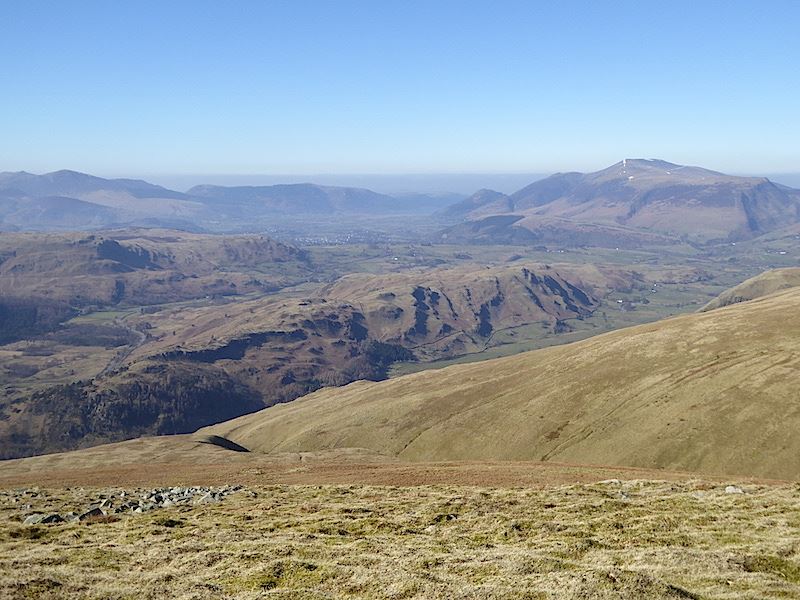
We found a sunny little hollow on the west side of Watson’s Dodd and got the lunch boxes out. The view is looking over High Rigg, the rather crumpled fell going across the middle, with the Skiddaw group over to the right.
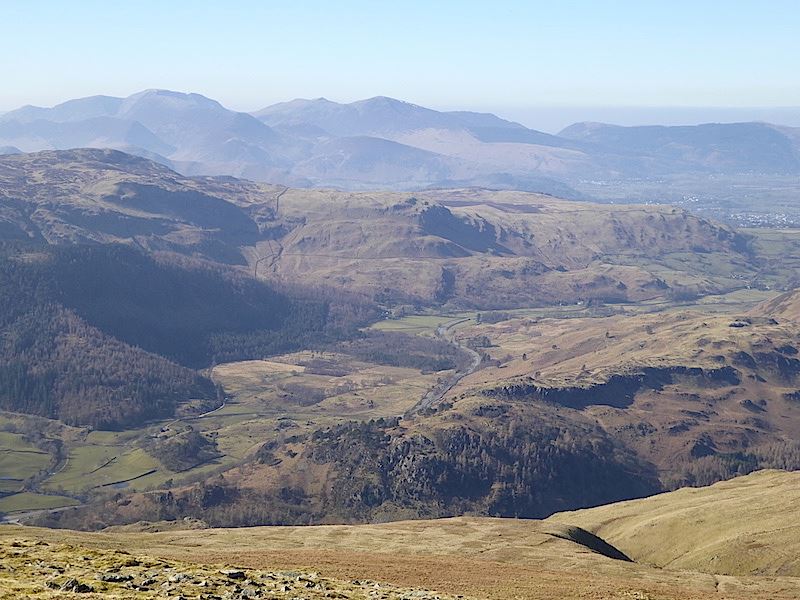
There was a lot of haze around today so there’s not much detail on the long distance views. Down below is the A591 snaking over to Keswick, its now partially open for a bus service to operate between Keswick and Grasmere, and also for walkers and cyclists to use. It is still closed to all other traffic as the road still isn’t fully repaired after it was washed away during Storm Desmond on 5/6 December 2015.
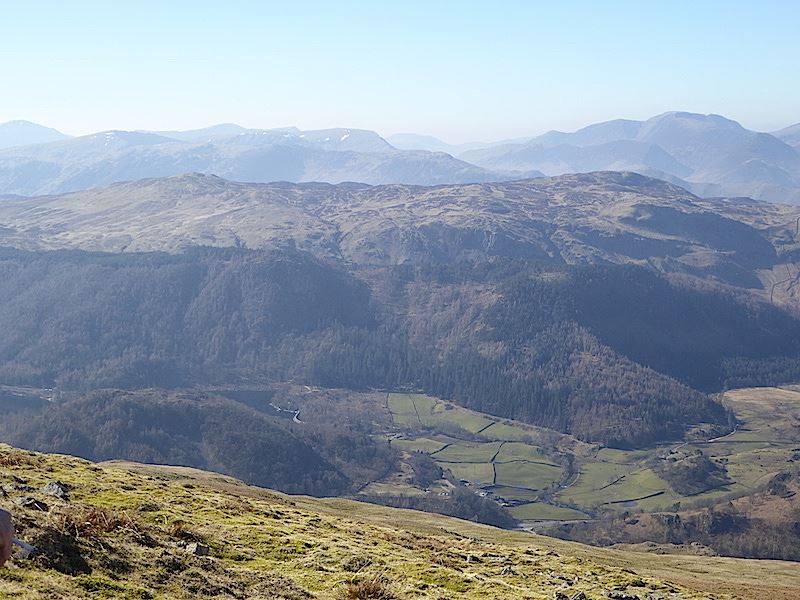
In the middle foreground are High Seat, on the left, and Bleaberry Fell on the right.
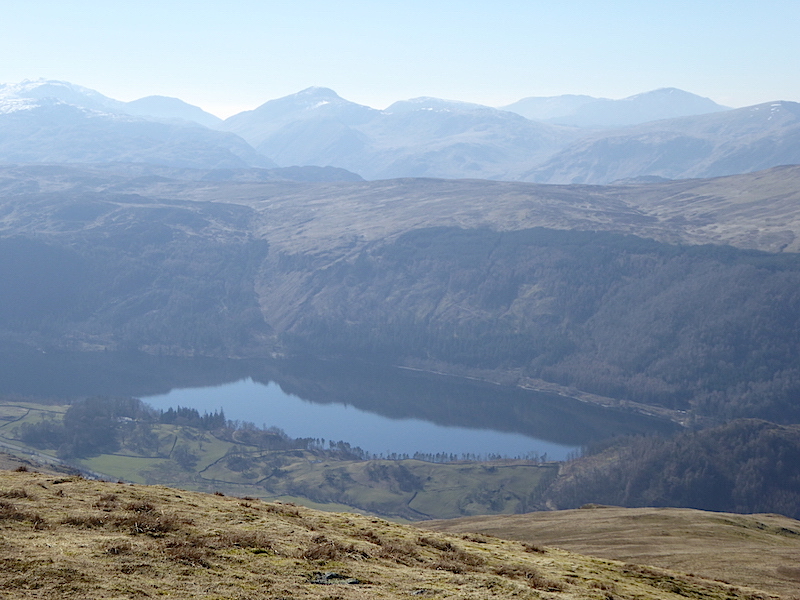
A view of Thirlmere and the fells to the west from our lunch spot.
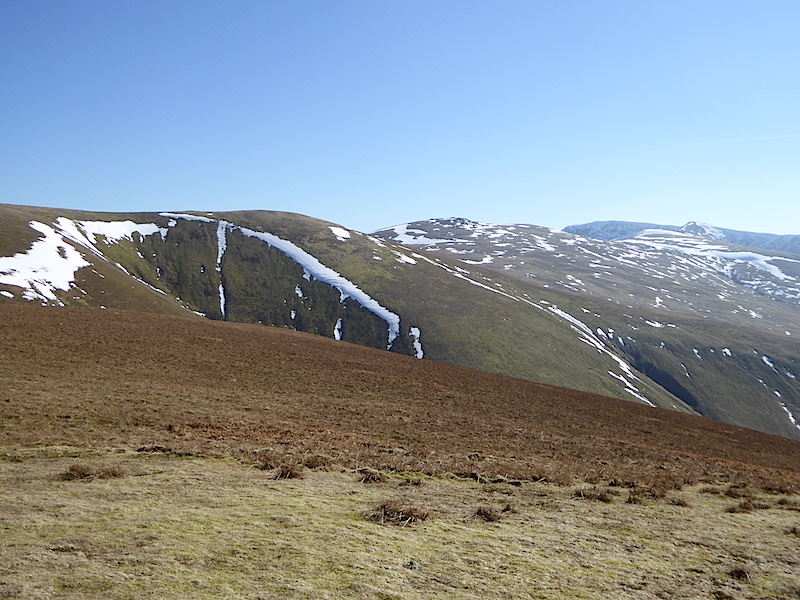
After spending a very pleasant half hour having lunch, and generally doing nothing but taking in the views, we began making our way back to Stybarrow Dodd.
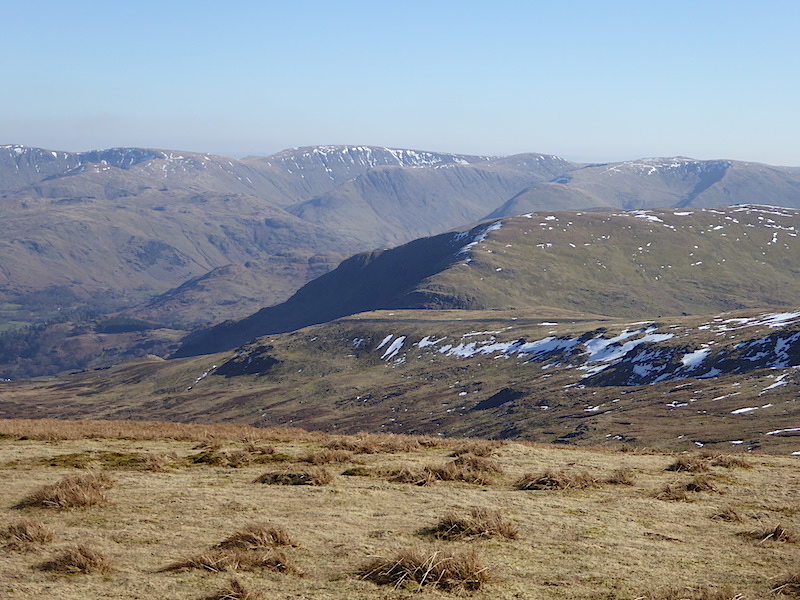
Back on Stybarrow Dodd and looking over to the eastern fells with the flat top of High Street in the centre.
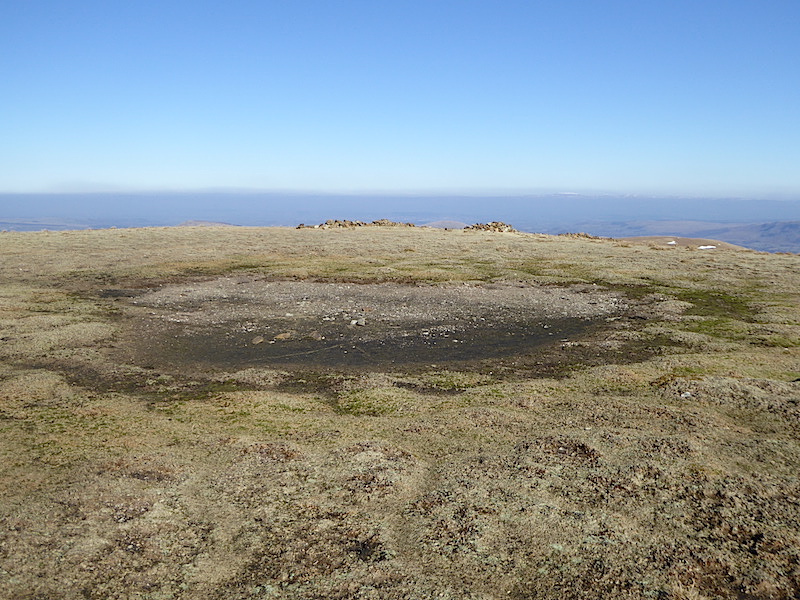
I wasn’t expecting to see a dried out Stybarrow Dodd tarn after all the rain we had over the winter.
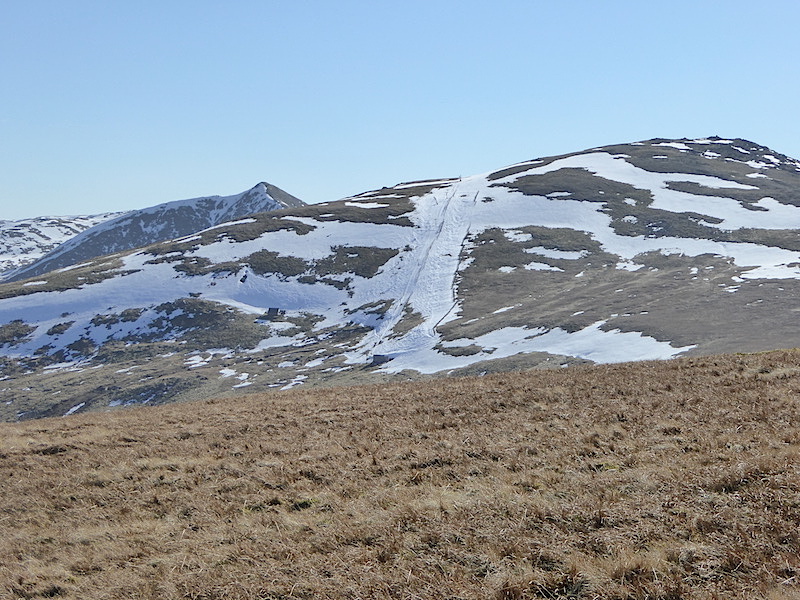
A close up of the ski run on the north side of Raise, we saw about half a dozen skiers using it today but if this weather keeps up the skis will have to go back into storage before much longer.
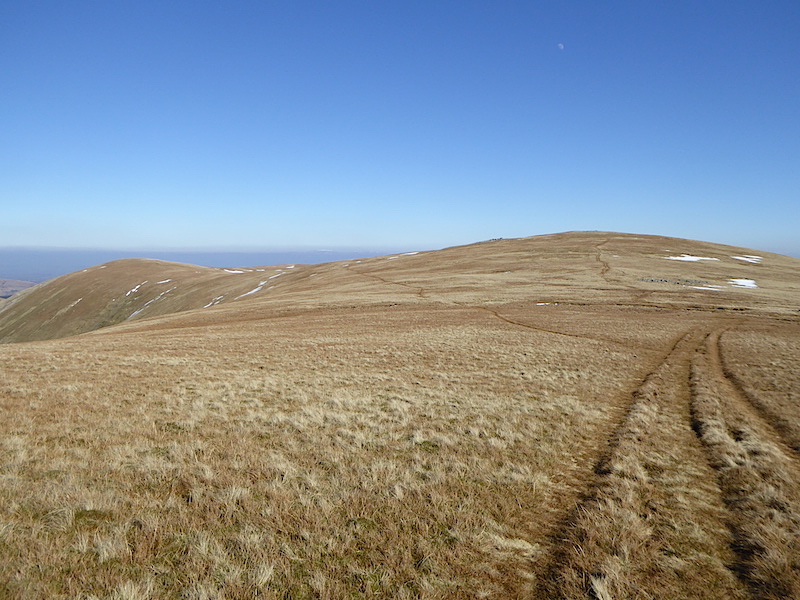
Tramping down from Stybarrow Dodd across open grassland, straight ahead is the summit of Green Side, while over to the left, and where we are heading, is the summit of Hart Side.
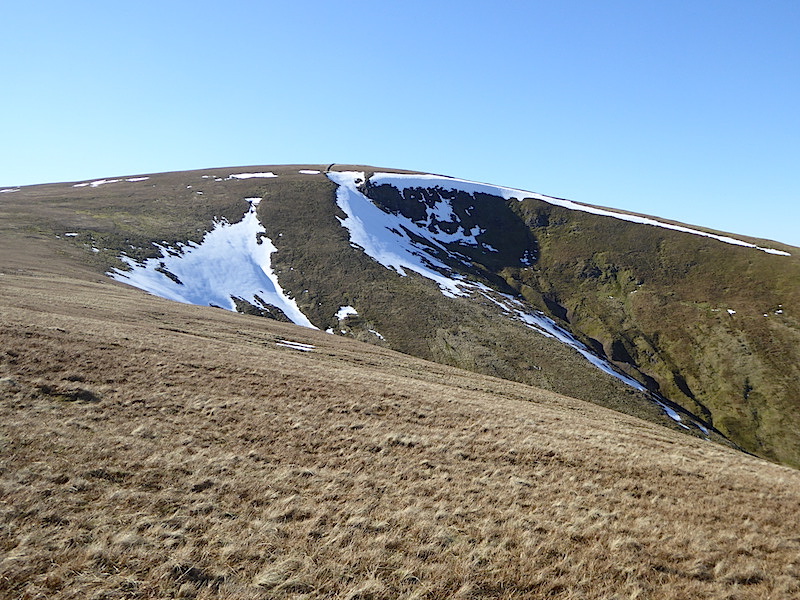
A look back at the eastern face of Stybarrow Dodd …..
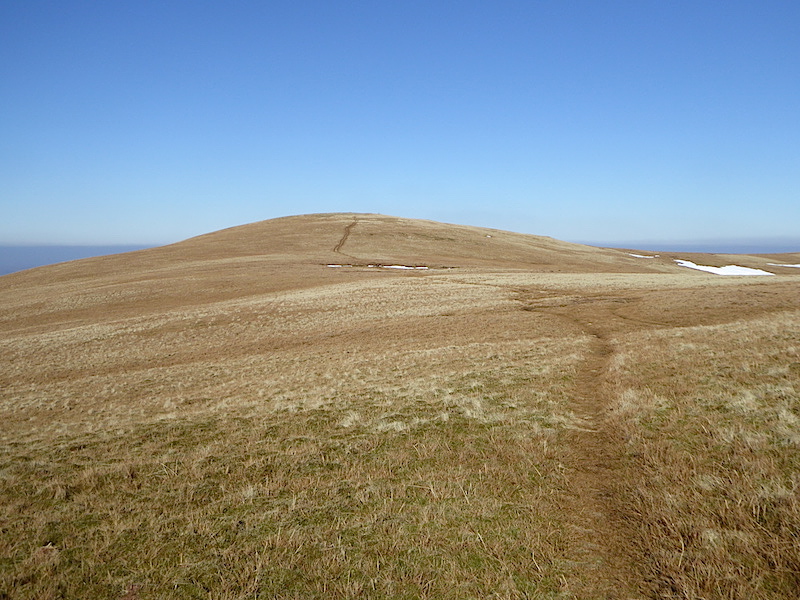
….. and a look ahead to the western side of Hart Side. Lovely easy walking and a treat for the calf muscles.
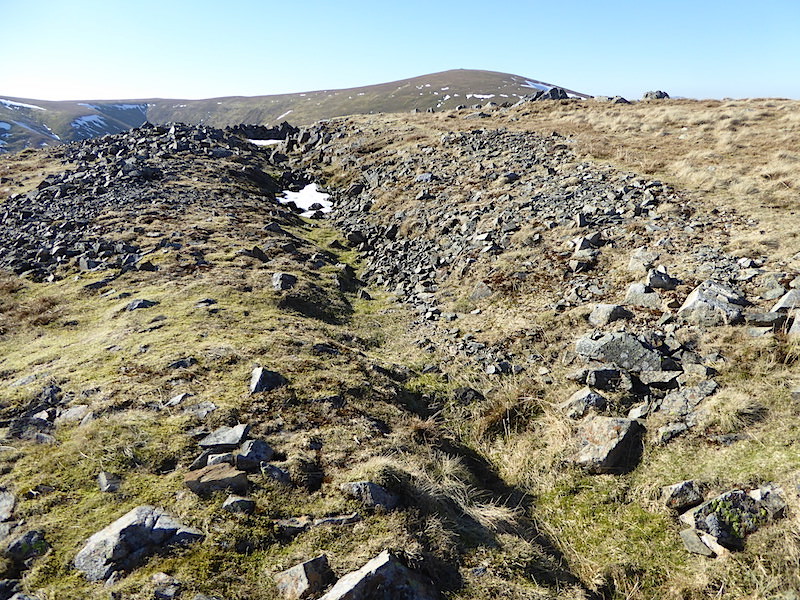
On Hart Side is this strange groove or ditch which may possibly be an old prospecting trench. The old Greenside lead mine isn’t far away so perhaps the two things are connected in some way.
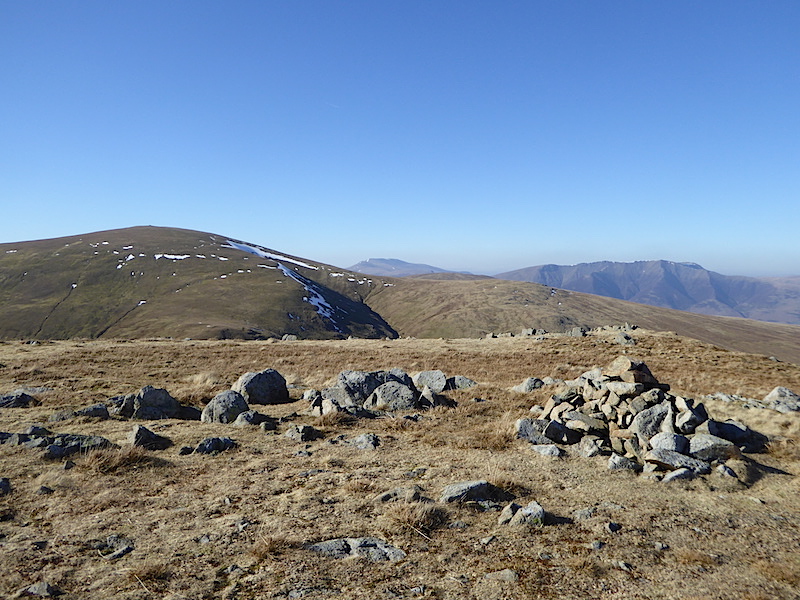
The rock strewn top of Hart Side looking towards Great Dodd, on the left, Skiddaw in the centre, and Blencathra on the right.
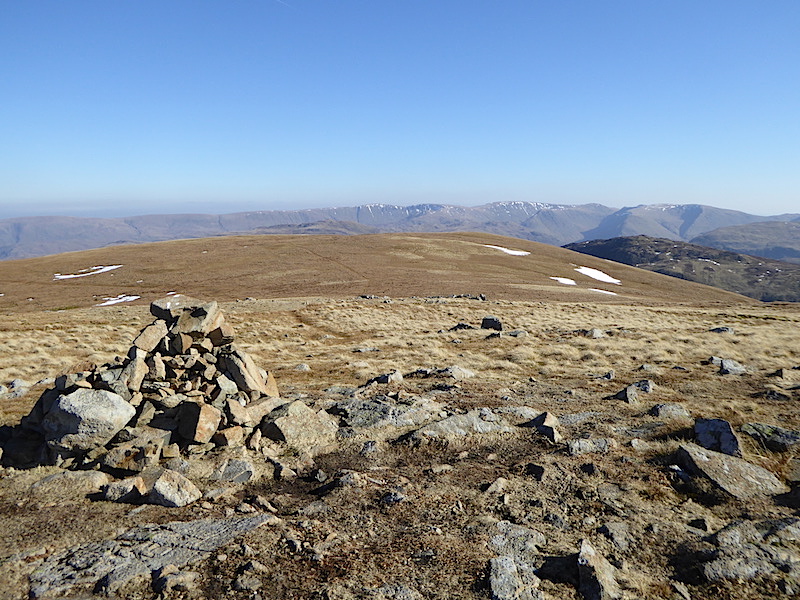
The view east from Hart Side and the path ahead which will take us back down to Dowthwaite Head.
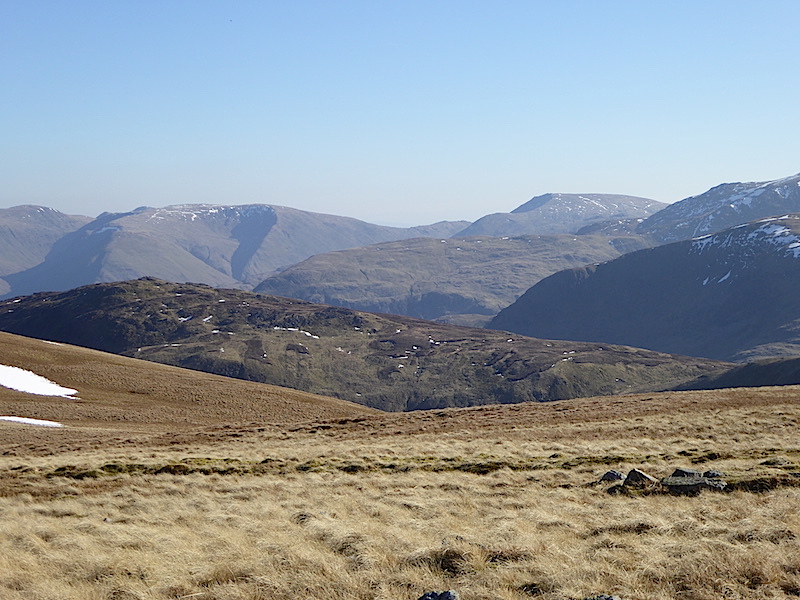
Sheffield Pike, the dark brownish fell, across the middle foreground with some of the eastern fells beyond it.
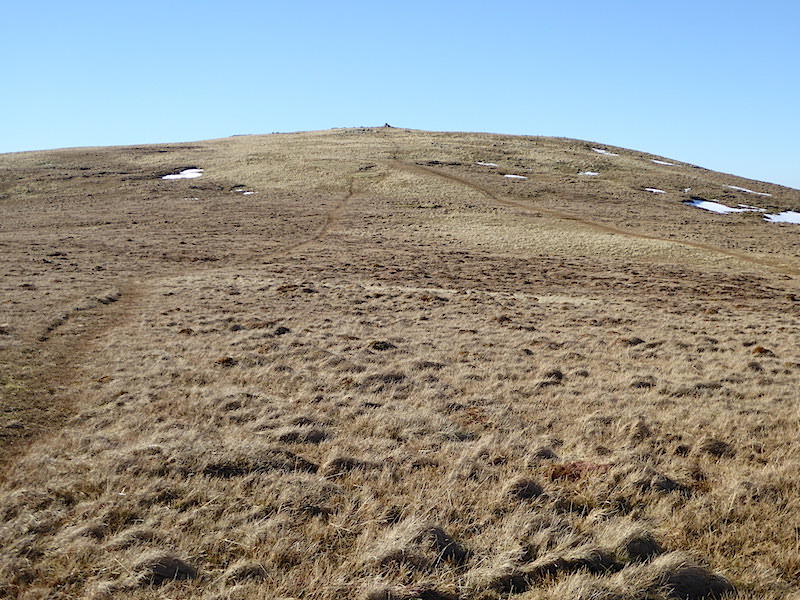
A look back at Hart Side, the path going to the right of the shot leads across to Birkett Fell.
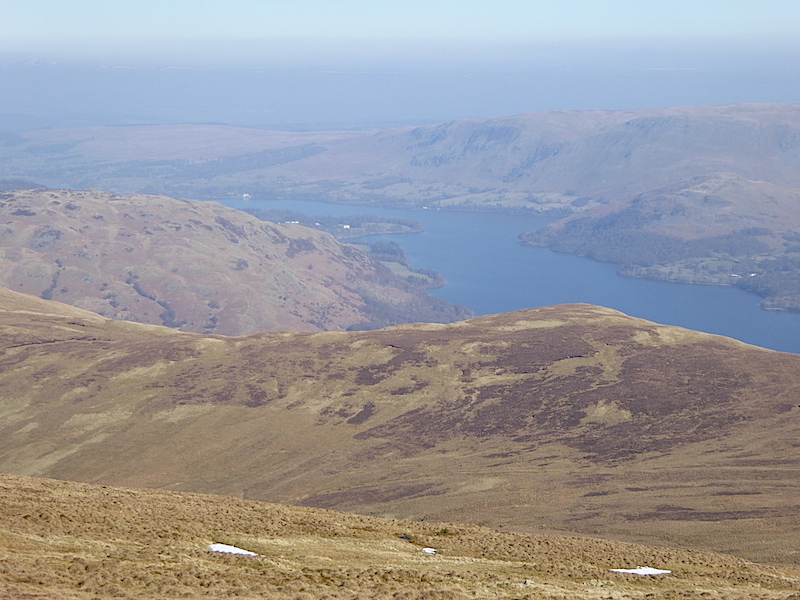
A view of Ullswater as we make our way down.
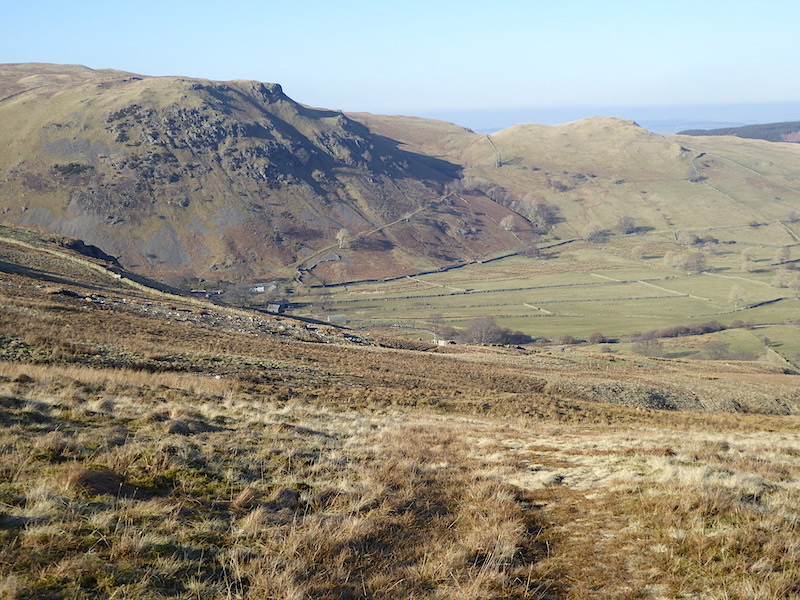
Looking down to the farm at Dowthwaite Head. Our return route will take us through the fields back to the car park.
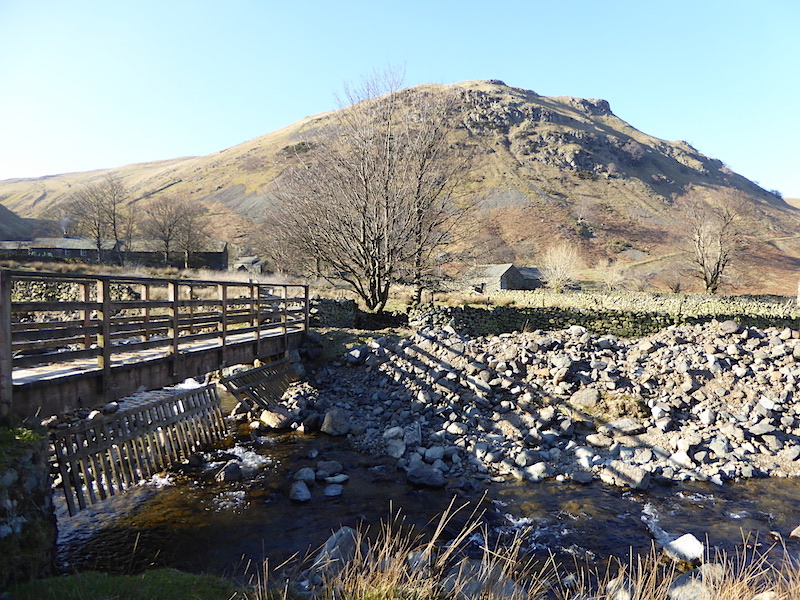
Dowthwaite Crag with the farm buildings below it.
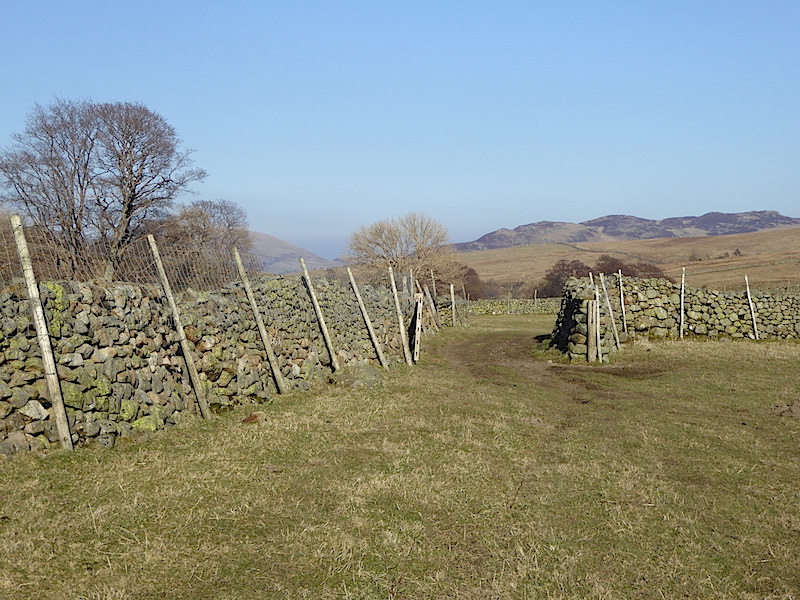
The return route through the fields to High Row with plenty of opportunities for cute lamb photos …..
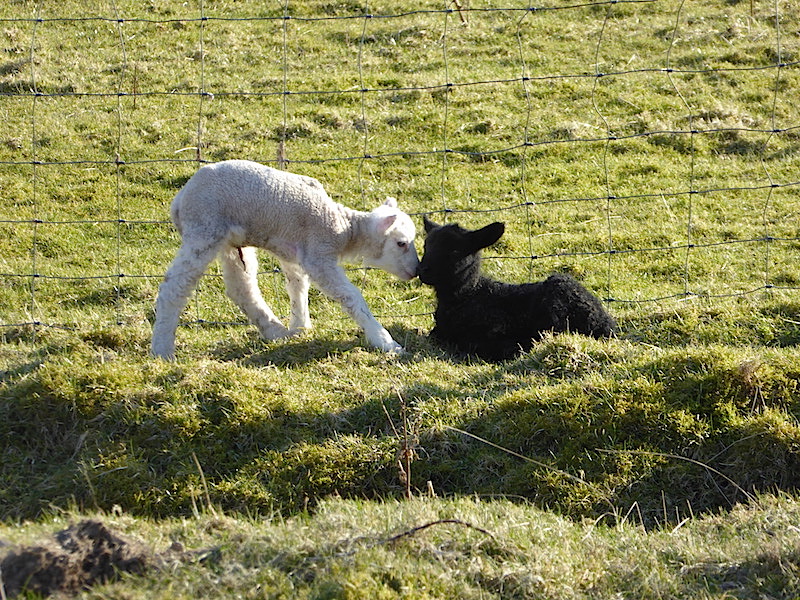
“Oh come on, stop being so sheepish, they’re only taking a photo.”
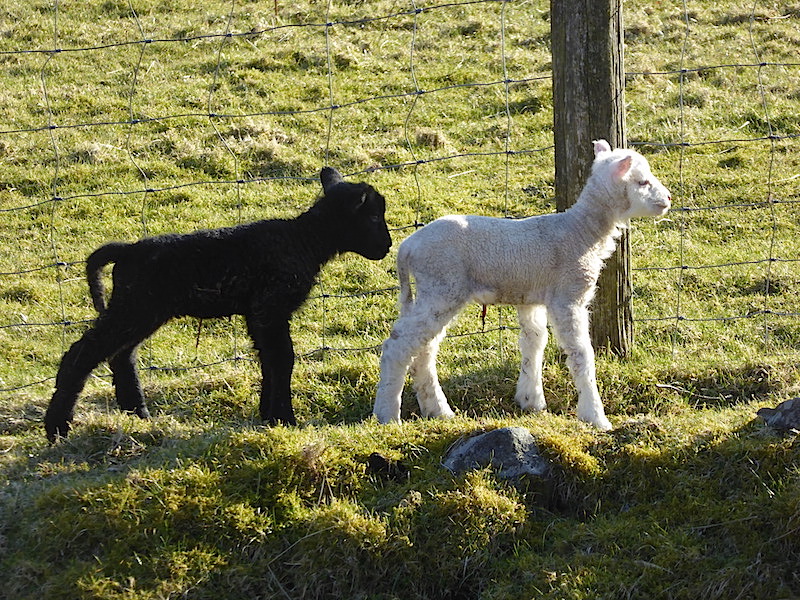
Just arrived, 100% pure wool jumpers – available in black or white.


Lord’s Seat, Broom Fell and Graystones

Walk Date – 14th March 2016

Distance – 6.5 miles

Weather – dry, warm and sunny


After a weekend of unremitting grey cloud cover and general low light gloom it was a treat to hear yesterday that the weather up here will be dry, settled and a good bit warmer for the next week or so. Its something to do with the jet stream apparently having shifted position and stopping all the cold, nasty, wet stuff getting at us. Anyway, I missed the detailed meteorological reasons because my thoughts immediately went off in another direction – its going to be a good day tomorrow, where shall we go? So this beautiful sunny Monday morning sees us parked near Darling How Farm on the track leading off the B5292 Whinlatter Pass road. One other car here already when we arrived and another one just coming up the track as we got out of our car.


Route

Here’s a view of Ladyside Pike over on the left as we get ready to start, the other car I mentioned is just turning up the track towards us.

Off we go then, along the main forest track into the Aiken Beck valley, to walk the 2.6 miles and ascend 1100 ft or so up to the top of Lord’s Seat. The track, wide enough to allow access for forestry vehicles, is like this for the majority of the way as it steadily climbs towards Lord’s Seat. Dry, firm ground under our feet for the first time in months and just look at that sky, its a fantastic morning to be out and about.

Looking back towards Graystones from the forest track, that will be the last fell on our walk today.

Over on the left is Broom Fell, which will be the second fell we visit today, and on the right is Lord’s Seat at the head of the valley.

We pass through a large area of cleared forest as the road begins to climb towards the head of the valley, you can just see the bare slopes of Lord’s Seat in the centre above the tree line.

Eventually a way-marker post beside the forest track indicates the start of the path through the forest. This is looking back down the track, it did get quite muddy and squelchy along this bit.

From the same place on the path a look ahead at where the track is leading, the shade was very welcome through here as the temperature was rising steadily and a couple of layers of clothing had already been removed.

After a short distance the path through the forest leads us out onto a heather clad ridge between Lord’s Seat and Ullister Hill. It was rather muddy up here too but there is a good path crossing it which is what I’m standing on to take this shot of Skiddaw and its neighbouring fells. Very little snow is left anywhere now and I think that will probably be the end of it until winter comes back round again.

Further along the ridge path through the heather and a view of Grisedale Pike on the left, Hopegill Head in the centre, and Whiteside over on the right. The brown and green coloured fell sandwiched in between is Whinlatter Fell.

The summit of Lord’s Seat comes into view. The laid path ends at the stile in the fence from where its just a short distance, up the well worn grassy path, to the summit. The lone walker up ahead was the driver of the car which was just coming up to the parking area in the first photo. We kept ‘leap-frogging’ one another all the way, we stopped to remove jackets, he passed us. He stopped further along to remove his jacket, we passed him, and so it went on all the way to the top. He passed us again at this point as I stopped to take some photos.

Over the stile and a view of Broom Fell, on the right, and the treeless summit of Graystones over on the left.

From Lord’s Seat summit the view looking towards the Skiddaw group of fells, with Barf, the heather clad fell, directly below us.

Bass Lake, looking very blue, with Binsey behind it.

Beyond Ullister Hill a view of Clough Head, and still with patches of snow, the Dodds and the Helvellyn range.

Lord’s Seat summit, no big fancy cairn here, just an old iron fence post and a meagre scattering of stones,

Taking in the views from Lord’s Seat summit.

There’s even a view across the Solway Firth of some of the mountains over in Dumfries and Galloway.

Time to head off to Broom Fell using the path over on the right. Its not a huge distance and, depending on how fast you walk, twenty to thirty minutes should see you on the summit.

A look over at the Skiddaw group over on our right as we start the descent off Lord’s Seat.

Almost at the bottom so I take a look back at the descent path from Lord’s Seat. The path was a bit slurpy here and there but stepping over on to the grass kept our footholds slither free.

Approaching Broom Fell summit.

Broom Fell has more summit ‘furniture’ than Lord’s Seat – a rather grand column cairn, a wind shelter, not forgetting the stile and the fence, of course.

Its quite a tall cairn too, as you can see, I didn’t measure it but it looks to be more than six feet high. Did I mention that it was windy up here? Notice the absence of fleecy top, jacket, hat and gloves, and I was wishing that I wasn’t wearing lined, winter weight trousers too. Its very warm for mid March.

Broom Fell summit.

From Broom Fell summit looking over to Graystones, the path over on the right is the one we’ll use to get there.

Making our way across the moorland path towards Graystones. It was a bit squelchy in places but nothing too unpleasant or difficult to deal with. You can really get a good stride and pace going along this sort of terrain.

A look back at Broom Fell from one of the squelchy sections across the path to Graystones.

We’re approaching Widow Hause, the path runs to the right of the tree line so we’ll be walking in shade for a while. Its no great hardship though as the sun is quite hot now, so we can cool down a little before the climb from the Hause up to Graystones summit.

There’s a short but quite steep climb from the Hause up to Graystones and we’d lost the tree shade, so we had a ‘brow mopping’ stop at this point. Above the trees in the centre is Broom Fell, with the snow topped Skiddaw just peeping over the top of it, and Lord’s Seat is now way over in the distance to the right.

A view down to Ling Fell, and out to sea, from the climb to Graystones.

Binsey on the skyline with Sale Fell below and in front of it.

That’s the climbing over and done with so now we’ll look for a little sun trap somewhere here and have our lunch.

We find a convenient and flattish area of rock for our lunch stop, which gave us this view looking south westwards. Out on its own over on the left is Mellbreak, over on the right is the rounded grassy hump of Fellbarrow, and on the centre skyline are Gavel Fell and Blake Fell.

Lunch break over and as we leave I take a look back at our lunch spot up there on that lowest group of rocks.

Its just a very short distance from where we had lunch over to the summit of Graystones, where we have this view of Broom Fell and Lord’s Seat with Skiddaw providing a majestic, late winter backdrop

Looking south from Graystones summit a close up view of, from left to right, Grisedale Pike, Hobcarton End and Hopegill Head.

Graystones summit.

Making our way along to the steep descent from Graystones.

Below us is Darling How Farm and the forest track we started out on earlier. Behind it, the tree covered slopes of Whinlatter Fell.

This is a very, very steep descent, thankfully dry and largely non-slip today. If you zoom in you might just be able to make out a walker down at the bottom. That’s the chap who kept leap-frogging us at the beginning of the walk, he even had his lunch only about 100 yards away from us back up on Graystones. I was glad to see him so far in front of us down there as his constant presence was beginning to irritate. I’m sure he wasn’t stalking us but it felt like it at times.

It was such a lovely day, and still only 1.30 pm so instead of descending right to the bottom we decided to extend our walk by crossing over the stile to walk along one of the forest tracks.

From the stile a look ahead along the forest track.

The track eventually brought us down alongside Aiken Beck …..

….. and then on to Spout Force, best viewed when the trees have lost their leaves and after lengthy periods of rain. Looks like we timed it right then.

Footbridge across Aiken Beck, but we continued along without crossing, making our way instead to the road at the end of the path at Scawgill Bridge.

Walking back up the road from the bridge to the car park I took this shot of Graystones. The descent path runs down alongside the wall and the forest.

Back where we started at Darling How Farm. Its still only early afternoon and it seems a shame to have to go home. As I’m changing out of my boots and stowing my stuff into the car boot I realise that this is the first time since 2nd November 2015 I’ve been out on a walk and not had to put my gloves on at any point, let’s hope I can put them away permanently before too much longer.


Gowbarrow Fell

Walk Date – 11th March 2016

Distance – 4.6 miles

Weather – dry but overcast and cool


The day started with a lovely sunny morning so we decided that, after the morning jobs were done, we’d go and take an afternoon walk up Gowbarrow Fell. Unfortunately, by the time we were ready to go, the weather had decided it didn’t want to play any more and so we ended up with a sky looking as though it had been given a coat of light grey emulsion which diffused what sunlight remained.


Route

Here I’m looking southwards from the start of the path which is just off the lay-by on the A5091, a short distance below Dockray.

The path eventually leads down to the High Cascades bridge which crosses Aira Force beck.

Looking upstream at the bridge at High Cascades.

From the bridge a look upstream for a view of some of the falls.

Another view from the bridge, this time looking downstream with the hazy sunlight casting a silver sheen on the water as it flows over the rocks and boulders.

A look back along the path which leads from the bridge out on to the open fell side. Not much to see thanks to the low light but Place Fell, the dark mass in the centre, can be identified easily enough.

We left the muddy, grassy path behind us at the gate, now we’re climbing up the muddy rocky one.

Thanks to the poor light the views were very indistinct, you couldn’t even see much detail on the fell closest to us which is Place Fell over to the left. To the right of it you can just about make out Glenridding Dodd rising up towards Sheffield Pike.

I suppose you could say this is what the ‘fag end’ of winter looks like. The sky is murky, the higher fells have snow but its thinning out gradually, the fields have the brownish green winter look of sheep having over-grazed it, and there is no sign yet of fresh green buds appearing on trees, shrubs and hedgerows. It feels as though everything is holding its breath before finally letting go and allowing spring to come bursting through. The snowdrops are out but I haven’t seen many daffodils yet, however, the first lambs are out in the fields though, so that’s a start.

Approaching Gowbarrow top where a group of young walkers are just about to depart.

The view north eastwards along Ullswater from Gowbarrow top.

The trig point on Gowbarrow with Great Mell Fell behind.

This time with Little Mell Fell behind the trig point.

Gowbarrow Fell summit.

A closer look at the snow and sky blending into each other over on the Dodds.

Without the close up this is what the view really looked like across there. Just to let you know what you’re looking at though, over there are the snowy tops of Stybarrow Dodd, Great Dodd and Clough Head.

“Can you be quick please, I’m getting blown away.”

A look back at the summit of Gowbarrow as we begin our descent and get out of the wind.

Looking across Ullswater towards Arthur’s Pike and Bonscale Pike.

The remains of the former shooting lodge. You can’t see this much of it in summer as the bracken grows high enough to cover it.

Another view of the shooting lodge from lower down the path.

To the right, on the shore line of Ullswater just below the snow capped fells, is Hallin Fell.

The terrace path along Gowbarrow. A lovely walk in summer but today I just got a little tired of looking at brown. The flip side of the brown will be the appearance of green in the form of fresh bracken and I don’t like that stuff either. You just can’t please some folk, can you?

Looking north eastwards along Ullswater.

The path passes above the Yew Crag viewpoint, but a very short detour down to the gate takes you on to it and some grand views up and down the length of Ullswater. Place Fell, in brood mood, behind it.

Looking towards the Glenridding end of Ullswater from Yew Crag.

This is the view looking the other way from Yew Crag.

On the centre skyline is the prominent peak of Heron Pike, to its right the ground rises up to Sheffield Pike, and to its left it drops down to Glenridding Dodd.

A look back at the Yew Crag viewpoint, on the right, with the memorial seat on the left.

A brown and brooding landscape. The only sound came from the road which you can see in centre at the bottom of the picture. Part of the road is closed at the moment while things are put to rights again after the storms so you could hear the machinery clanking away, getting things back to normal again in time for Easter, we hope.

Lyulph’s Tower with its mock castle facade. although all you can see from here is the back of it.

Aira Force in good flow.

A close up of the upper section of Aira Force.

The lower bridge just below Aira Force.

Aira Force and the pool its drops into from the viewing platform about halfway up the steps. A small section of the lower bridge is in the shot at the bottom right.

You don’t have to stay on one side or the other of the beck as there are plenty of crossing points. We kept to the path going off to the left today.

High Force.

Finally, we’re back where we started at High Cascades bridge. From here there’s just a very short walk now along the path behind me back to the car park. Gowbarrow is a handy little fell when you only have a morning or an afternoon to spare, its just a shame that the morning sunshine didn’t last.


Mardale Ill Bell via the east ridge

Walk Date – 28th February 2016

Distance – 5 miles

Weather – dry with sunny spells, cold under cloud cover


We hadn’t really planned any walk today as the forecast last night seemed a bit neither one thing or the other, apart from the fact that it wouldn’t be hot. Thanks to that we didn’t have a very early start or we could have done a longer walk. Seeing that the morning was a bright, clear and crisp one we decided to drive over to Mardale and see if the Storm Desmond landslip had been cleared, and based on that make a decision on what we’d do next.


Route

The view from the drive along the side of Haweswater was impossible to ignore so we pulled up at the road side from where I took the above photo and the following two. This one is looking over at Kidsty Pike, the pointy one, across Haweswater on an absolutely beautiful morning.    

The wooded promontory, named The Rigg, in front of the ridge path leading up to Rough Crag, with High Street, to the right, beyond it. Mardale Ill Bell is over on the left.

Looking along the road towards Mardale Head with Harter Fell on the left, and a snow capped Mardale Ill Bell to the right of it. Slivers of surface ice showing on Haweswater.

All you need to know about Haweswater on the information board in the car park at Mardale Head. The fact that we are in the car park means that the landslip has been cleared so now another part of the Lakes is available to walkers.

Today’s objective, Mardale Ill Bell.

Harter Fell casting a shadow across our route as we make our way up to Small Water. This is a grand little section of the walk, it leads up to Small Water tarn and starts quite gently as can be seen in the photo. It continues to rise very steadily so there are no very steep sections, and for a good part of the way the path runs alongside Smallwater Beck with its attractive waterfalls. The views back towards Haweswater get better and better as you climb and if all you can manage is a couple of miles or just have an hour or so to spare then this is the walk for you.

Looking back at Haweswater with thin films of surface ice here and there.

Looking over to the Rough Crag – Long Stile approach to High Street.

Very icy paths today but it wasn’t worth putting the spikes on as the ice was easily side-stepped by using the solid grassy ground on either side.

One of the waterfalls in Smallwater Beck.

Icicles clinging to the rock in Small Water Beck.

Mardale Ill Bell across a frozen Small Water. The path across the tarn continues around it and on up to the Nan Bield Pass, but when we are over that little grassy rise we will turn right off the main path and continue on to the summit via the east ridge, which is indicated by those two knobbly lumps on the right skyline. We won’t be walking over the top of them though as the route passes below them.

Nan Bield Pass, the low point on the skyline, across the outflow at Small Water.

We’ve turned off the main path now and we’re climbing more steeply. Time for a breather and a look at the ice patterns on Small Water.

Selside Pike in the sun and Branstree in the shade across Haweswater.

A glimpse of Haweswater and an un-named tarn.

The summit plateau of Harter Fell, with a sliver of Small Water below it

A better view of Small Water from higher up and further along the route.

A look back to Haweswater as we climb higher.

Kidsty Pike, on the centre skyline, across Caspel Gate, which is the brownish patch just below it. We put the spikes on around this point as we were about to climb across a large area of thick and frozen snow.

Safely up the snow patch at the top of which is this old quarry building. Those old quarry men chose a good site for their hut, it would be a great place to sit and get the ‘snap tin’ out after working hard in the quarry all morning.

Another view of the old quarry building, this time looking south to the Nan Bield Pass.

The low point on the skyline is the top of Nan Bield pass, the ridge to the left of it leads up to Harter Fell.

Harter Fell and Small Water from the quarry building.

Looking towards High Street. We don’t need to cross that patch of snow as our route now goes off over a level section to the left of the shot.

The view across to our right of the north ridge of Mardale Ill Bell.

We’re just below the summit at this point and its a good spot to see the size and shape of Haweswater.

We’re almost at the summit now and the ground has lost much of its steepness. The summit plateau of Harter Fell is opposite.

A couple of minutes later and we’re at the summit of Mardale Ill Bell, complete with ice block installation.

Harter Fell from Mardale Ill Bell summit.

The view eastwards from Mardale Ill Bell summit.

Yoke, Ill Bell and Froswick from Mardale Ill Bell summit.

A close up of Thornthwaite Beacon from Mardale Ill Bell summit.

Looking across to High Street from Mardale Ill Bell.

Looking between Yoke and Ill Bell for a close up of the sunlight glistening on Morecambe Bay, a long way down to the south.  We could have done with some of that, its all gone a bit grey over here.

The view to the south west from Mardale Ill Bell.

We walked to the west for a short distance to get some shots of Blea Water. This glimpse of Blea Water was the best I could manage as I wasn’t too keen on walking into that snow so close to the edge to get a better one.

Looking across Long Stile to Kidsty Pike, that’s the little rocky bump on the skyline just above the cloud shadow.

Returning to Mardale Ill Bell summit cairn, still sporting its block of ice.

Descending Mardale Ill Bell with a view of Kentmere reservoir below Yoke and Ill Bell.

The view down to Small Water and Haweswater as we leave Mardale Ill Bell.

On the way down to Nan Bield Pass.

The shelter at Nan Bield Pass, busy at the crossroads today. The path to the right leads up to Harter Fell summit, the walker in yellow has just walked up from Small Water, and the path going down to the right leads down to Kentmere.

The path from the shelter leading up to Harter Fell summit.

Kentmere reservoir from the Nan Bield shelter.

The Nan Bield shelter from the eastern side.

More icy sections on the Nan Bield Pass as we make our way down.

Small Water and Haweswater as we descend the Nan Bield Pass.

Safely down at Small Water.

The stone shelters alongside Small Water.

Not far to go now to the car park at the end of the road. I haven’t worked out why but there’s always seems to be a bit of an optical illusion going on when taking a photo of Haweswater from this area. It looks as though the water is sloping to the right, which it obviously isn’t since it would be spilling over onto the road and the car park. I always check the horizontal level on the camera to get things perfectly level and take several shots, just in case, but they still come out looking weird.


Ard Crags and Knott Rigg

Walk Date – 25th February 2016

Distance – 6.8 miles

Weather – sunny start, cloud cover later, not too cold


Route

Its a beautiful morning and we’re parked at the old quarry area by Rigg Beck for a walk up to Ard Crags and Knott Rigg. Its been quite a while since we had a walk up here, almost seven years in fact, so a return visit is long overdue. This is looking up Rigg Beck with Causey Pike just peeping out over on the left.

Just a few paces along the path and the three distinctive crests on Ard Crags, on the left, come into view.

Further along the path with Ard Crags to the left, Sail in the centre, and Scar Crags to the right. The three crests on Ard Crags are clearer to see from this angle.

A look back at the crossing point over Rigg Beck. Although crossing over the stones looks fairly straightforward, the water level today was such that it was covering most of them so we had to cross at a point off to the left of the shot where the banks were quite close together, and where only a long stride was needed to get us across quite easily.

From the beck, down at the bottom left, the path rises across the fell side and leads on to the ridge path.

On the left is the path we’ve been following which reaches the ridge and joins with another coming from the far end of the ridge. A view of Catbells in the centre of the shot as we take a look back at the view.

Turning round we view the very steep climb up to the first crest, this is Aikin Knott. That’ll mean a few pit stops on the way up there then.

The view eastwards from the top of Aikin Knott. Aikin Knott? Aching yes!

Causey Pike on the left and a view of Blencathra on the centre skyline from the top of Aikin Knott.

From left to right on the skyline are High Spy, Dale Head, Hindscarth and Robinson as we continue along Aikin Knott.

A brief spell of level walking before the second crest, the east summit, on Ard Crags has to be tackled. The legs are very grateful for this brief respite.

A look down into Keskadale before we start the second climb up to the east summit.

On the other side of us is Causey Pike.

On the west side of us, as we reach the east summit, is Rowling End in sunshine and shadow, with a view northwards beyond it. The path up here is quite straightforward but it is only wide enough for one foot at a time so its a bit like tightrope walking. The heather on either side was growing across it as well which was a bit of a nuisance. Heather is the sort of plant whose stems seems bent on wrapping themselves around your boots, as if deliberately trying to slow you down, or even trip you up. Sneaky stuff is heather.

Looking the other way, to the east,  the skyline shows some of the snow capped Dodds to the left, and to the right, part of the Helvellyn range. Adding drama to the view was the constantly changing cloudscape above them all.

A look back at the path leading from the east summit across to the west one.

Another view of Causey Pike with Blencathra beyond. The patch of woodland down there looks to have found itself a nicely sheltered little sun trap, no wonder its thriving. That might be worth exploring one of these days.

Still climbing and taking a look back at the east summit with Aikin Knott just below that. Rigg Beck is now a long way below us over to the left.

At last the path levels out and now we’re making our way along to the highest point on Ard Crags, the west summit.

The long ridges of Hindscarth and Robinson, and Keskadale Beck, stretching down towards the Newlands Valley.

Ahead of us, on the left, is the summit of Ard Crags.

Looking back at the east summit with Aikin Knott just below it. To the bottom right of the photo is the road we will walk back on.

Looking south west to the snow capped  High Crag – High Stile – Red Pike range. The fast moving cloud is playing havoc with the lighting and plunging us into deep shadow every few minutes.

The view south west from the  insignificant heap of stones marking Ard Crags summit.

Causey Pike and Blencathra from a very windy Ard Crags summit.

Looking ahead to Knott Rigg summit, the little sunlit patch in the centre.

Hindscarth and Robinson getting some sun on their backs.

The view west from the summit. From left to right are Whiteless Pike, Wandope, Crag Hill and Sail.

Looking back along the Ard Crags ridge with Causey Pike and Blencathra to the left, and Clough Head and Great Dodd on the right skyline.

The bowl shape over on the left, between Wandope and Crag Hill, is Addacomb Hole.

View down into Keskadale as we leave Ard Crags summit.

Wandope, Crag Hill and Sail from further along the ridge.

A few more ups and downs still to go before we reach Knott Rigg summit.

The view east from the short col between Ard Crags and Knott Rigg. The first fells at the end of the fields are Catbells and Maiden Moor, behind them the darkish mass is the long ridge between Bleaberry Fell and High Seat, and on the skyline Clough Head, the Dodds and the Helvellyn range.

A look back at Ard Crags summit from the col.

Climbing out of the col on the way to Knott Rigg.

A look back along the route from Ard Crags …..

….. and a look forward at the route to Knott Rigg. So far we have met only one other walker all the way along this ridge.

On the skyline from the left are Red Pike, Starling Dodd and Great Borne. Over on the right is Whiteless Pike.

On the left, Sail, Scar Crags and Causey Pike, with a long look back along the ridge route we’ve followed.

On the left the long ridge between Scar Crags and Causey Pike.

The summit of Knott Rigg, no trig point, no cairn, no shelter, just this scrape of rocks. However, we did meet three more walkers, from Lancashire, who had puffed and panted their way up here from Newlands Hause. One of them, a short, stout chap and very red in the face gaspingly asked me if this was the top. When I said that it was he said ‘Thank god for that, he’s been saying we’re on the top now for ages, but every time I looked in front of me there was another bloody hill to get up!” The he to whom he was referring was another  member of the group who had brought his brand new gps along for its very first outing and was just getting to grips with how things worked. The red faced man didn’t need a gps to tell him he wasn’t at the top, all he’d needed to do was to look ahead and groan. Of course, we now have four blokes and a gadget so man talk about these gadgets ensued. I went off to take more photos …..

The view south west from Knott Rigg.

Robinson from Knott Rigg. The sunny morning has disappeared, the clouds have joined together and ganged up on us to block out the sun.

Looking over High Snockrigg to High Stile, in the centre, and its neighbouring fells.

Whiteless Pike from Knott Rigg.

The conversation about satnavs comes to an end and we can get under way again. A close up view of Newlands Hause as we descend from Knott Rigg.

Robinson from the descent of Knott Rigg.

One of the knottier sections of Knott Rigg.

The view down to Newlands Hause and Moss Force as we descend.

The road from Newlands Hause down to Buttermere.

Nearly down at Newlands Hause.

A look back up from the start of the climb up to Knott Rigg. No doubt the red faced chap and his mates thought that was the summit when they started out, and I wonder how many other people walk up there thinking the same, only to find that it isn’t when they get there?

Moss Force tumbling down the slopes of Robinson.

A long stretch of road walking lies before us, although there’s plenty of grass to walk on if  there is a lot of traffic. The road is supposed to be closed but there was some occasional traffic passing us. More about the road closure later.

A look back up the valley, not a soul around.

There are views of Blencathra and Catbells ahead of us for most of the return leg.

Catbells and Maiden Moor across the valley.

The reason for the road closure, a culvert on the verge of collapse just below Keskadale Farm. Another victim of Storm Desmond.

A view of the culvert from the other side. Looks as though the fencing has been blown down in the subsequent storms.

Further along the road was this large landslip which had started way up above us …..

….. and this is the other side of the landslip. The roadway has been cleared but a lot of debris is still lying around in the fields.

On the left is Catbells and over the right is Maiden Moor, and no, I haven’t lost my sense of balance, the fence really is at that acute angle. Perhaps the person who installed it had good reason to place it like that.

Hindscarth and Robinson, the Newlands valley heavyweights.

Milk churns and and an old plough on display at Birkrigg.

The ‘new’ house which is just across the road from the quarry car park, about a dozen paces to the left of the shot. It was completed in 2011 so I suppose we shouldn’t call it ‘new’ any more.

This is what used to be here and was known by everyone as ‘The Purple House”. Apparently it started life in 1881 as The Newlands Hotel and ended it as a guest house before becoming virtually derelict. It was sold at auction in 2007 for £470,000, then demolished and eventually replaced by the house in the previous photo.


A Watendlath Wander

Walk Date – 22nd February 2016

Distance – 5.8 miles

Weather – dry, cloudy and cool, with an occasional glimpse of sunshine


Route

This wasn’t anything like the weather we were supposed to be having today. A frosty but bright and sunny day was the forecast which tempted us out, but all we got was a blanket of cloud and cool, damp air. It was hardly designed to lift the spirits after yet another rain soaked Saturday and Sunday.  But here we are, walking up the Watendlath road from the car park near the bottom of it. No fells are being climbed today as most of them have their tops shrouded in cloud and there wouldn’t be any good views, so its a just walk up to Watendlath and then the walk back down again.

Its not a huge distance from the car park up to Ashness Bridge so in no time at all we’re almost at the bridge. Taking advantage of the fact that there was no-one else around for once, I took a few shots of the bridge as I knew when we got back here the place would be very busy as usual. The following are the shots of the bridge …..

Continuing along the tarmac road from the bridge and passing Ashness Farm.

Derwentwater in sombre mood beneath sullen grey skies. The view from Surprise View. (The viewpoint is marked on the route map with a blue symbol shaped like half a daisy flower if you want to know where I’m standing.)   

Water, water, everywhere. The southern end of Derwentwater is under water once again. It had been drying out but much of the snow has melted, so the melt water and the weekend rain have covered the area again.

A lone photographer had set up his camera and tripod just below those rocks and was waiting patiently for some better light. He mentioned that he had been at Buttermere at 5.30 am, then had come here in the hope of brighter conditions, only to be disappointed once more.

A short distance from Surprise View a path diverges from the tarmac road and leads down to Watendlath Beck. There was a notice saying that the bridge was out of use as it was damaged during Storm Desmond so we went down to have a look.

The ‘out of use’ bridge, and beyond is the path we had just walked down to get to it. The damage is at the far end of the bridge and if you look closely you can see that there is a gap between the end of the bridge and the stone pier by the bank. So if its out of use how did we get over to this side of the beck? Perhaps its best just to gloss over that.

Watendlath Beck flowing down to flood Derwentwater a bit more.

Reecastle Crag across the beck.

Reflections in a puddle on the path.

No problems crossing here, everything was intact but we had a look just in case.

A look back down the valley from the beck side path.

The crags and boulders of Grange Fell.  Perhaps its better not to think about where all these rocks and boulders have come from and just keep walking.

Goat Crags on the opposite side of the valley.

A handy set of steps taking the path over a higher section, although the collapsed deer fencing was a bit of hazard at times.

Plenty of ups and downs along this section of the path.

Looking back down Watendlath Beck valley, Ether Knott on the left and Reecastle Crags on the right.

We turn a corner and Watendlath comes into view.

Plenty of water rushing down Watendlath Beck today.

Watendlath bridge, also damaged during Storm Desmond and closed for the time being. Judging from the debris on the scaffolding the water levels have been very high again since it was installed.

This temporary crossing was quickly installed after the storm. It was definitely in place just a couple of weeks after the storm. Notice the construction, no piers as such, just huge tree trunks resting on either bank and held in place by a couple more placed crossways to them, which in turn are prevented from moving by the wooden stakes driven into the ground, simple and quick. Why couldn’t that be done at the ‘out of use’ bridge, its not as if we’re short of fallen trees.

The little hamlet of Watendlath. Pronounced with the emphasis on ‘end’ so its WatENDlath and even though I know that I still mispronounce it.

The view from the other side of the bridge.

Over on the other side is the path leading up to Grange Fell. Here I’m standing at the outflow end of Watendlath Tarn. Over to the left there’s a net strung across to stop the fish in the tarn making a bid for freedom and escaping to Derwentwater.

Great Crag, on the right, across Watendlath Tarn.

Not many people about at the tarn today, but it will be a different scene altogether when spring and summer arrive.

The waterside path heading off towards Great Crag.

The only action around here was the drakes chasing the ducks, its getting to be that time of year I suppose.

Old domestic and farming items serving as planters in a Watendlath garden. Those galvanised dolly tubs were all the rage before the electric washing machine came along, together with wash (or rubbing) boards, wash dollies (in our house called a ‘posser’) the obligatory bag of Reckitt and Colman’s Dolly Blue, and outside in the yard, a big mangle with wooden rollers. Ee, by ‘eck, them wer’t days! Childhood memories come rushing back.

An old hay turner in the cafe garden.

Fold Head Farm, the gold coloured ornament on the wall being the only bit of sun we saw today.

The side view of Fold Head Farm with the tarn just beyond.

The cafe garden, a cup of tea and a piece of cake would have very welcome but it wasn’t open today.

The entrance to the cafe garden.

After our wander around Watendlath we begin making our way back down the tarmac road, Ether Knott ahead of us. That’s the name printed on the map but I can’t help wondering if its really meant to be called Heather Knott.

From the road a look across at the some of the crags of Grange Fell.

Passing below Reecastle Crags and plenty of water running off the fell sides all the way back down.

Ghostly silver birches clinging to the crags.

Fresh hay, the ovine equivalent of fillet steak.

Who Dares, Wins.

‘Don’t you know its rude to watch while people are eating?”

It must be some form of solid feed cake, but whatever it was they were certainly enjoying it.

Looking back in the direction of Watendlath.

‘ROAD SUMMIT’ it says on the stone, so here we are on the highest point on the Watendlath road. The moss covered stones in the woods are typical of this area of woodland.

Back at Surprise View and the weather hasn’t improved. The lone photographer has packed up and gone, and so has everybody else.

Derwentwater through the trees as we make our way back to the car park. Well it wasn’t the brightest of days but we’ve had a good leg stretch, plenty of fresh air and it didn’t rain, hallelujah.


Latrigg

Walk Date – 18th February 2016

Distance – 5.2 miles

Weather – dry, sunny spells, not cold, slight breeze on the top


The spell of cold, dry weather has come to an end for the time being. It rained all day yesterday so the drying out process  has been stopped in its tracks. However, there’s a good forecast for today, before the rain returns tomorrow, so I opted for a solo walk up Latrigg.


Route

Here I am on Spooney Green Lane starting out for Latrigg which is up ahead of me.

The Skiddaw fells, with their tops camouflaged by cloud and snow, from Spooney Green Lane.

My outward route took me over the busy A66, the return leg will also involve crossing this road but that will be by a similar bridge further up the road there.

Some of the things you might see in Latrigg woods.

Looking across Keswick and Derwentwater to the north western fells. I had to remove one layer at this point, even in the shade it was quite warm work.

Two old gateposts at the first bend in the path. I had to wait a minute or two here as I could hear voices below, it turned out to be two runners charging their way up the path. I wish I could  run and talk at the same time, well come to think of it, I just wish I could run!

What you might see in Gale Ghyll Woods.

The Skiddaw group of fells, still with their heads in the clouds.

At this point the path becomes a series of hairpin bends each providing a gently rising section of path.

The north western fells from the signpost. You can see how the path rises gently across the fell side, and how steep the ascent would be if it wasn’t there.

Another hairpin bend from the remains of a very old gatepost.

Another hairpin bend, but I am almost at the top. The deep grooves in the path the result of torrents of water running down during all the storms we’ve had and simply washing it away.

At the end of the hairpins is a seat with a view. Keswick is down below, at the northern end of Derwentwater, with the north western fells beyond it.

From this angle you can just see a little of Bass Lake over on the right. The little fell along its shore, with a splash of sun on it, is Barf.

Unfortunately there was quite a bit of cloud around this morning so the snow capped tops of the fells are not very distinct.

The view behind the seat. As you can see I’m not at the summit yet and that hump on the skyline isn’t it either.

Nobody but me up here at the moment.

I was just about to leave when Grisedale Pike suddenly got a splash of sunlight on it.

A rather misty shot of High Rigg, down there in St John’s in the Vale.

Walking across the broad top of Latrigg with a view of Clough Head, on the right, and the two Mell Fells over on the left.

There isn’t anything which marks the highest point on Latrigg but this scrape of rock is the generally accepted summit.

Over to my left are the cloud covered fells which are clustered below Skiddaw.

Snow capped Clough Head, and to the right of it you can just make out the slopes of Great Dodd. I had to put the hood up along here as it suddenly became very breezy.

The snow capped fell in front is Blease Fell, which is really the western shoulder of Blencathra.

I chanced a shot to the south while there was some cloud cover. In the centre is Bleaberry Fell, and the flat-topped, dark shape below it to the right is Walla Crag.

A look back as I begin to make my way down Latrigg.

A flat and broad expanse of grass makes for pleasant walking down off Latrigg.

Farm vehicles have made the grooves which were already there even deeper in the very wet ground, and although it wasn’t icy you were only a wrong step away from an unwelcome sit down, as it was very soft and slippery underfoot along here.

Another look back before the view disappears.

The grassy track eventually gives way to this gravel one, it passes through a group of gorse bushes and you have a view of Clough Head all the way along.

At the end of the gravel track is the junction with Brundhome Road. I turned right at the junction for the road walk back into Keswick. If you look carefully you’ll find a view of Robinson between the twigs on the lowest branch on the right hand side.

It was quite warm walking along here with the sun over on my left and sheltered from the breeze by the slopes of Latrigg on my right. There’s a clearer view of Robinson over there on the skyline too.

More storm damage. Down on my left the River Greta is flowing through the valley. During Storm Desmond the swollen river washed away large sections of the fell side and caused several landslips. The landslips have ripped the tarmac apart.

The damaged road from the other side. I kept coming across sections like this all the way along the road. A little further along from here the road had a barricade across it with a ‘ROAD CLOSED’ sign attached to it.

I’ve yet to walk along a forest road without coming across stacks of felled tree trunks somewhere along the route. I thought they had a lovely orange glow to them in the sunlight.

This is the second bridge crossing over the A66. Its not very pleasing to look at, but at least I have a view of Catbells as I cross over the noisy road.

Approaching the Calvert Trust Riding Centre, with quite a good view of Robinson in the centre behind it.

An even better view of Robinson through the trees a little further along the road.

A close up of the snow capped Robinson above the green slopes of High Snab Bank.

Sunny Robinson opposite a dark and brooding Causey Pike.

I’m about 100 yards away from the car as I reach the end of my walk and take this shot of Latrigg.

Finally, a view of Dodd, the little sunlit fell on the left, with Carl Side to the right. Two horses in their winter rugs are grazing in the field below, and two more walkers, by the gate on Spooney Green Lane, are just starting their walk up Latrigg. When I arrived there was only one car parked on Brundholme Road. When I returned two hours and twenty minutes later it was as full as a millipede’s sock drawer, I’m glad I came early.


Arnison Crag and Birks

Walk Date – 15th February 2016

Distance – 3.25 miles

Weather – dry, sunny, very cold north wind


The spell of dry weather is still with us so we are making the most of the forecasted sunny day and taking a walk up to Arnison Crag and then over to Birks. Its not a long walk but it has plenty of variety and just enough height to get us above the  current snow line.


Route

The path starts just to the left of the photo from the car park which belongs to The White Lion pub across the road there.

The path starts easily enough and passes alongside this marshy area known as Mill Moss.

After clambering over some icy rocky outcrops the path leads us towards a wall, which is hidden at the moment but its close by those trees. At the wall there is a choice of routes, going straight on through the gate will take you on into Glenamara Park, while turning left and not going through the gate will lead up to Arnison Crag. For the first time in months we have dry, solid ground beneath our feet, no mud or water to wade through, I’d quite fogotten what that felt like.

We didn’t go through the gate but turned left and began the climb up. All you have to do is follow the wall so navigation is easy, the difficult bit arises from the steepness of the path. AW gives the distance from the start point to the summit as three quarters of a mile with 1000 feet of ascent and my leg muscles have never found any reason to disagree with his calculations. Its a grassy path too so the sheep eat it down to ground level, and today it was icy thanks to last night’s snow flurry followed by a very hard frost. It was a bit like trying to walk up a sloping skating rink.

A look down at another particularly steep section alongside Oxford Crag, the longer grass alongside the wall gave a better foothold and the fence came in handy as a bannister. There are good views of Ullswater while you wait for your leg muscles to stop complaining.

Across the valley are Birkhouse Moor, on the left, and Sheffield Pike, on the right. The sunlit area in front of them is known as Glenamara Park, although its not the sort of park which has swings, slides, putting greens and a bandstand.

The gradient eases just a little beyond Oxford Crag and I’m still using the long grass and dead bracken rather than the icy path.

Between Ullswater and St Patrick’s Church below us is evidence of the debris left behind after the recent floods, and heavy machinery was thumping and clanking continuously in Glenridding over to the left, where huge amounts of stone and gravel were dumped by the flood waters.

Place Fell and Ullswater from Arnison Crag. This is the generally accepted summit although it isn’t quite the highest point. That is a little further along the ridge but its simply a grassy dome and not as interesting as this rocky platform, which needs only a little bit of a scramble to get to.

Yes, its a lovely sunny day but there was a very cold north wind on the summit and I had no idea what I was looking at since my eyes were streaming with water. Seconds after wiping it away it would be back again, just as bad as before.

Gavel Pike, the eastern shoulder of Saint Sunday Crag in the centre, and Birks to the right, from Arnison Crag.

Directly across from us is Birks which is where we’ll be heading for next.

The view to the south west  from Arnison Crag. Over on the left is Red Screes just sticking out above the long ridge of Hartsop above How. Also on view behind that ridge is Dove Crag, in the centre, then Hart Crag and a bit of Fairfield, with Gavel Pike and Saint Sunday Crag over on the extreme right.

Looking eastwards and the most dominant fell is Place Fell.

Looking south eastwards across Patterdale, the two tops of Angletarn Pikes on the left and the knobbly top of Brock Crags to the right of them. Gray Crag is over on the extreme right with High Street behind it.

On the skyline is the east ridge of Saint Sunday Crag, whose summit is way over on the right.

A bank of cloud obligingly moved in front of the sun so I could take a due south shot of the ridge of Hartsop above How.

While I had some cloud cover I took a closer shot of Dove Crag, Hart Crag and part of Fairfield on the lower end of the skyline.

We’re just about frozen solid after standing around for a few minutes taking in the views so we begin heading down off Arnison Crag summit.

Below us is the path which will lead us over towards Birks. Not a lot of folk about up here today, they’re probably snuggling up to a nice warm radiator, not everybody is as daft as us.

A view along Patterdale towards Hartsop village. The village is tucked away round the corner behind the lower slope of Brock Crags.

Passing below the rocky top of Arnison Crag, its much more interesting than the grassy domed highest point.

Looking back at Arnison Crag, with Angletarn Pikes over on the right, as we make our way over to Trough Head.

Place Fell on the skyline, with Arnison Crag just below it. Easy walking along here and the wind was behind us for the most part.

Making our way towards the lower slopes of Birks.

Some of the eastern and far eastern fells on view over to our left, Gray Crag is in the centre with High Street behind it, Hartsop Dodd is to the right of it and Caudale Moor, which is over on the extreme right of the skyline.

In the centre, Brock Crags, Angletarn Pikes to the left of it, and to the right of it, Gray Crag. The snow covered far eastern fells beyond them.

The winner of today’s most unusual cloud competition.

Fantastic cloud formation beyond Saint Sunday Crag. There were lots of unusual cloud shapes today but I thought this one was one of the more extraordinary ones.

The north wind may be perishingly cold but it does bring clear air with it. The clear cold air brings out the detail on the fells.

Knowing that there would be little by way of shelter from the cold wind on top of Birks we decided to get out the hot soup on the sunny slopes of Cold Cove, just below the col between Birks and Saint Sunday Crag. Here we were out of the cold wind and enjoying some very warm sunshine, courtesy of some convenient flat topped rocks. We had some good views to go with the soup and on the skyline are some of the snow covered far eastern fells. The next photo shows a view just a little to the right of this one.

Coldcove Gill to the bottom right of the shot.

Fortified by the hot soup we begin to make our way up to the col between Saint Sunday Crag and Birks. Our view is of the north east ridge of Saint Sunday Crag, the summit is over towards the left just in front of that bit of wispy cloud behind the skyline. It doesn’t look it but the snow was about a foot deep over here and hiding fat clumps of tussocky grass so it was  tough going for a while. In places the frozen crust would hold but in other places it didn’t and down you’d sink onto a tussocky clump, you definitely need the walking poles to keep your balance on this sort of stuff.

From the col, a view of Catstycam over on the right with the summit of Helvellyn just above the shaded V over on the left. The long ridge of Striding Edge running across the middle of the shot.

As we turn up towards Birks summit I take a look back at Saint Sunday Crag’s north east ridge on the left and part of the Helvellyn range on the right. Just before we reached this point we met a couple who had been trying to walk up the ridge path but had to abandon it because it was too icy and they didn’t have any spikes with them.

Heading across the top of Birks towards the summit, which is in the centre of the picture. Firm, crunchy snow under our feet now as the route has been well trodden, so the going is good.

The broad top of Birks with Place Fell just showing behind it.

Approaching the summit of Birks with Ullswater beginning to appear again.

A look back at Saint Sunday Crag and the Helvellyn range as we make our way across Birks.

The two of us on a very cold and windy Birks summit.

A look back as we start to descend from Birks.

A lovely view of Ullswater as we make our way towards Thornhow End.

Sheffield PIke on the left and Glenridding Dodd, with the two rows of cottages below it, just to the right of it.

Me and my shadow looking towards Place Fell. The camera went back in its case at this point as we are about to walk down to that lighter brown area towards the bottom left of the picture. That’s where the path down Thornhow End begins and its steep so you need to concentrate on getting down safely rather than fiddling around with a camera.

Safely down, so I take a look back at Thornhow End, our route down from Birks. I think its clear why you need to concentrate.

At the end of the path down Birks we take a right turn along this path through Glenamara Park with a view of Arnison Crag ahead of us.

A little further along the path and we have a view of the whole of Arnison Crag.

Crossing Hagg Beck, where a lot of stone debris has been deposited during the recent floods.

Looking back at the Hagg Beck crossing.

A view of Ullswater from the walk back through Glenamara Park and it was a whole lot warmer down here out of the wind.

Silver Birches glowing in the sunlight as we reach the end of the path. Its only a short walk from the gate back to the car park so today’s short, but very enjoyable, walk comes to an end.


Steel Knotts

Walk Date – 13th February 2016

Distance – 2 miles

Weather – thick cloud, cold east wind, some sleet


Yesterday’s walk around Hallin Fell reminded us that we last walked up Steel Knotts in 2014 so, as today’s forecast was a bit on the gloomy side, we decided to spend a couple of hours walking up there this morning. Its near home and of modest elevation so we were unlikely to be up in the cloud, although there wouldn’t be much we could do about any of the forecasted sleety showers which might come our way.


Route

On the drive to Howtown I caught sight of one of the Ullswater steamers, ‘The Lady Wakefield’, beached during Storm Desmond. The crew themselves then had to be rescued. The vessel is damaged and likely to be out of action until April this year.

A close up of the vessel through a gap in the hedge.

We drove on up the Howtown hairpins to St Peter’s Church car park from where you get this view of Beda Fell.

Right behind us is St Peter’s Church, Martindale where we were yesterday.

Towards the left is the path to Steel Knotts via Birkie Knott, we’ll be using that as our descent route later on.

Our route to the summit takes us past Lanty Tarn with Beda Fell behind.

Across from us is Hallin Fell and a little bit of blue sky. Blimey, where did that come from?

We made a slight diversion from the path to this viewpoint along Martindale.

Back on our route again and down below is the bridge over Howegrain Beck which we crossed yesterday.

Winter Crag Farm down in the valley with Winter Crag behind it. Just behind the very dark yew tree is the old church of St Martin.

Winter Crag Farm again, and now we’ve moved further along more of the old church comes into view.

Its all looking a bit grey and gloomy over The Nab, on the left, and Beda Fell, on the right.

More blue sky over Beda Fell.

The Nab,  in the centre,  with the fields below it still partially flooded after all the recent storms.

Continuing along the higher path which traverses the slopes of Steel Knotts.

Above and behind us is the summit of Steel Knotts. You could climb straight up but its very steep and the route we are taking is easier on the legs.

Another look down into a rather soggy Martindale.

The traverse path we used came out, from the right, at the flattish area just below us. At that point we turned left to bring us up to here. Turning to the right at that point would eventually lead you up to the High Street range of fells, the slopes of which you can just about make out through the low cloud. Its not a good enough day to be up there in all that cloud with the cold east wind cutting through you.

From the same point as the previous shot but turning round to see the summit of Steel Knotts directly ahead of us. It really isn’t as hard as it looks.

A look back from further along the path, with limited views of the fells beyond Gowk Hill and The Nab.

Pikeawassa, the summit of Steel Knotts.

Taking shelter behind the summit rocks, no climbing up them today, its a bit too windy for that.

There was a biting east wind up here today. Its coming in directly behind me which is why I’m huddled in front of the summit rocks.

look back at the summit as we start the descent from Steel Knotts. It was far too cold to hang around and the views were limited.

The Pooley Bridge – Howtown section of Ullswater from the descent path. The Pooley Bridge pier is at the far end close to that small conical hill, and the Howtown pier is tucked away in that crescent shaped bay just above the brownish slope below us.

Quick, get a shot of that sun on Hallin Fell before it disappears.

Descending Birkie Knott with Hallin Fell directly ahead of us. The Howtown hairpins over on the right of the shot.

A little bit of Ullswater showing below Gowbarrow Fell with Lanty Tarn and St Peter’s church directly below us. One of those sleety showers came over as we were making our way down, but it didn’t bother us too much.

A look back at our route down Birkie Knott. The camera threw a wobbly after I’d taken this shot and refused to focus properly so there are no more photos today. It did the same thing just before the guarantee expired so there was no charge for the repair. The warranty on the repair has now expired, ho hum.


Around Hallin Fell

Walk Date – 12th February 2016

Distance – 3.7 miles

Weather – dry with sunny spells but a cool east wind


The morning has been taken up with routine chores, but we still have a decent afternoon of weather so we decide to do one of those walks that you’re always going to do, but never quite get around to it. We’ve walked up Hallin Fell many a time but never all the way around it. After parking at Howtown we cross the road and take the path which will take us all the way around the fell.


Route

From the path this is the view across Ullswater towards Dunmallard Hill at the end of the lake.

Over on our right is Bonscale Pike with Arthur’s Pike just peeping out behind it.

The terraced path on the lower slopes of Hallin Fell.

Below Bonscale Pike is Mellguards, the white building in the centre, with the Howtown ferry pier just below it.

Steps going down to the path which leads to the ferry pier.

The view really opens up once you are clear of the small wooded area.

Arthur’s Pike, in the centre, catching some sunshine.

The view along Ullswater from the terrace path below Hallin Fell.

Another look across to Arthur’s Pike and Bonscale Pike.

Half of Ullswater, the other half bends around the left of the shot, ending at Glenridding. Its a very long lake, roughly 20 miles all the way around it.

A view of Swinburn’s Park as we approach Geordie’s Crag.

Geordie’s Crag in the foreground, with Gowbarrow Fell over on the left.

Arthur’s Pike and Bonscale Pike from Geordie’s Crag.

The view along Ullswater from Geordie’s Crag.

Continuing along the rocky path from Geordie’s Crag. Don’t slip here or you’ll be in for an early bath.

Gowbarrow Fell, which stands along the southern section of Ullswater which ends at Glenridding.

The view through the trees near Kailpot Crag.

Kailpot Crag.

Roots and rocks at Kailpot Crag.

Approaching Hallinhag Wood.

Blue skies over Gowbarrow Fell.

The path though Hallinhag Wood.

Its good to see the Ullswater ‘steamer’ back in service after the floods. I didn’t see it until it was almost past so it was a bit of a scramble to get the camera out in time before the boat disappeared behind the tree branches.

The path with views of Ullswater ends here at Sandwick Bay, from here its mostly a walk along the narrow tarmac lanes.

A look back at the path, lots of water still around …..

….. and plenty of it still running across the fields.

Looking towards the southern end of Ullswater.

Very slowly the water is draining away, but the debris left behind shows by how much Ullswater overflowed onto the land around it.

The remains of an old building above the path. The path runs alongside the wall but it was much too muddy to use.

Flood debris in front of Beckside Farm.

Gowbarrow Fell behind the ruined farm buildings.

Sandwick Beck,  flowing on its way down to Ullswater,  from the bridge across it.

The gate at the end of the bridge, we didn’t visit the tea room today.

One of the cottages in the hamlet of Sandwick, which I understand is pronounced Sanick.

Part of Beda Fell with the snow covered fells of the High Street range behind.

Hallin Fell.

The western side of Beda Fell.

The beck and the lane part company at this point.

Beda Fell was nicely lit so I thought it would make a good picture, but by the time I’d got the camera out …..!

We’ve just come from Sandwick so its on to Howtown next.

Hallin Fell from the lane to Howtown.

The fire is going well in Hallin Bank farmhouse, its only mid-afternoon but you can feel the temperature dropping already, the chilliness is added to by the keen east wind.

Steel Knotts ahead of us as we continue down the lane.

The bridge over Howegrain Beck with Steel Knotts in the background.

The eastern side of Beda Fell.

Still doing the job for which it was intended, Queen Victoria would be proud.

The ‘new’ church of St Peter, Martindale, consecrated in 1882. The ‘old’ church of St Martin is down the valley about half a mile away. The date that church was established is unknown but there is a mention of it in a charter of 1220.

A look down at the Howtown hairpins, our car is parked on the patch of green over on the right, opposite the start of the path around Hallin Fell.

Well, that’s today’s walk almost at an end and there’s no need to risk life and limb walking down the road as there are numerous paths across the grass. We could have walked down the road quite safely today though as there was very little traffic.